



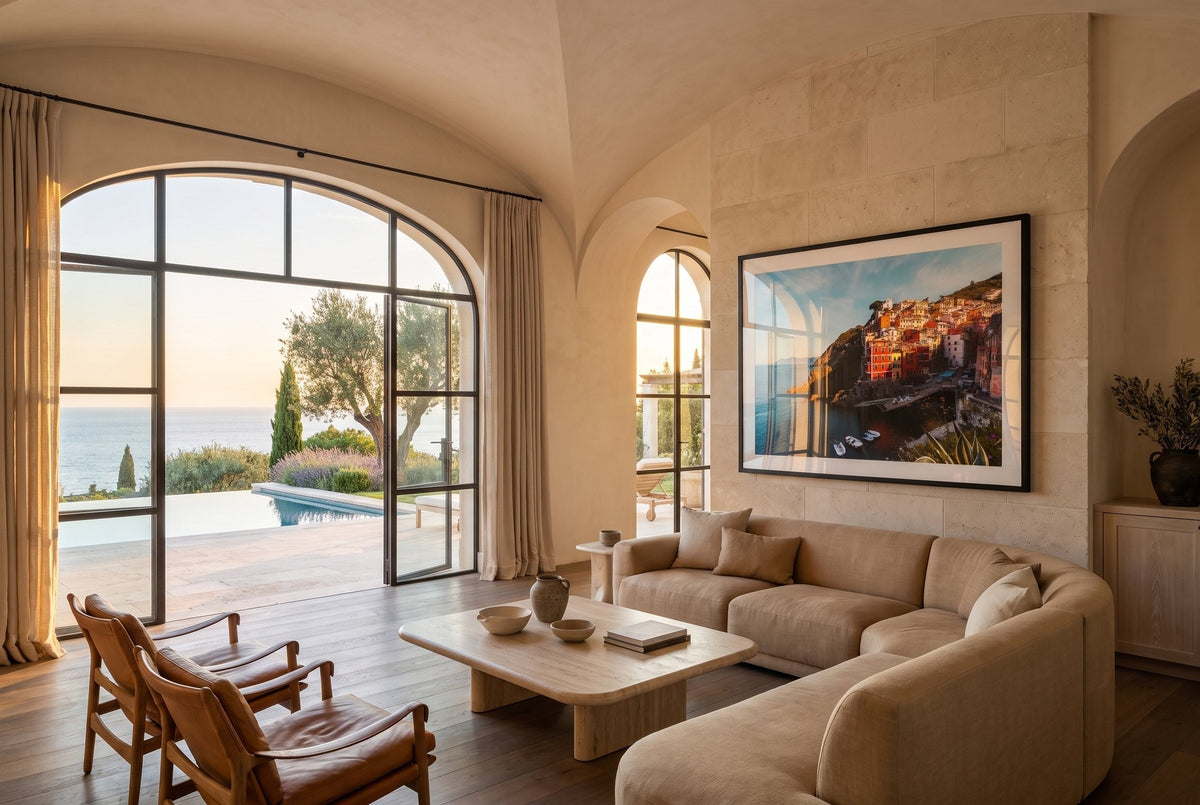
A room can be beautifully designed and still feel like something is missing.
The furniture might be right. The colours might work. The lighting might be considered. But an empty wall can make the whole space feel unfinished.
Wall art changes that.
Not because every wall needs to be filled, and not because art should simply match the sofa. The right piece of art gives a room personality. It can remind you of somewhere you've been, somewhere you want to go, or simply create a feeling you want to live with every day.
As a photographer, this is one of the things I find most interesting about seeing a photograph leave the camera and eventually become part of somebody's home.
The photograph hasn't changed.
But its purpose has.
Wall art makes a home feel personal
There is a difference between decorating a house and making it feel like yours.
Furniture often has a practical purpose. A sofa needs to be comfortable. A dining table needs to fit the room. Storage needs to work.
Art doesn't have that same responsibility.
That gives you more freedom.
You can choose something simply because you respond to it.
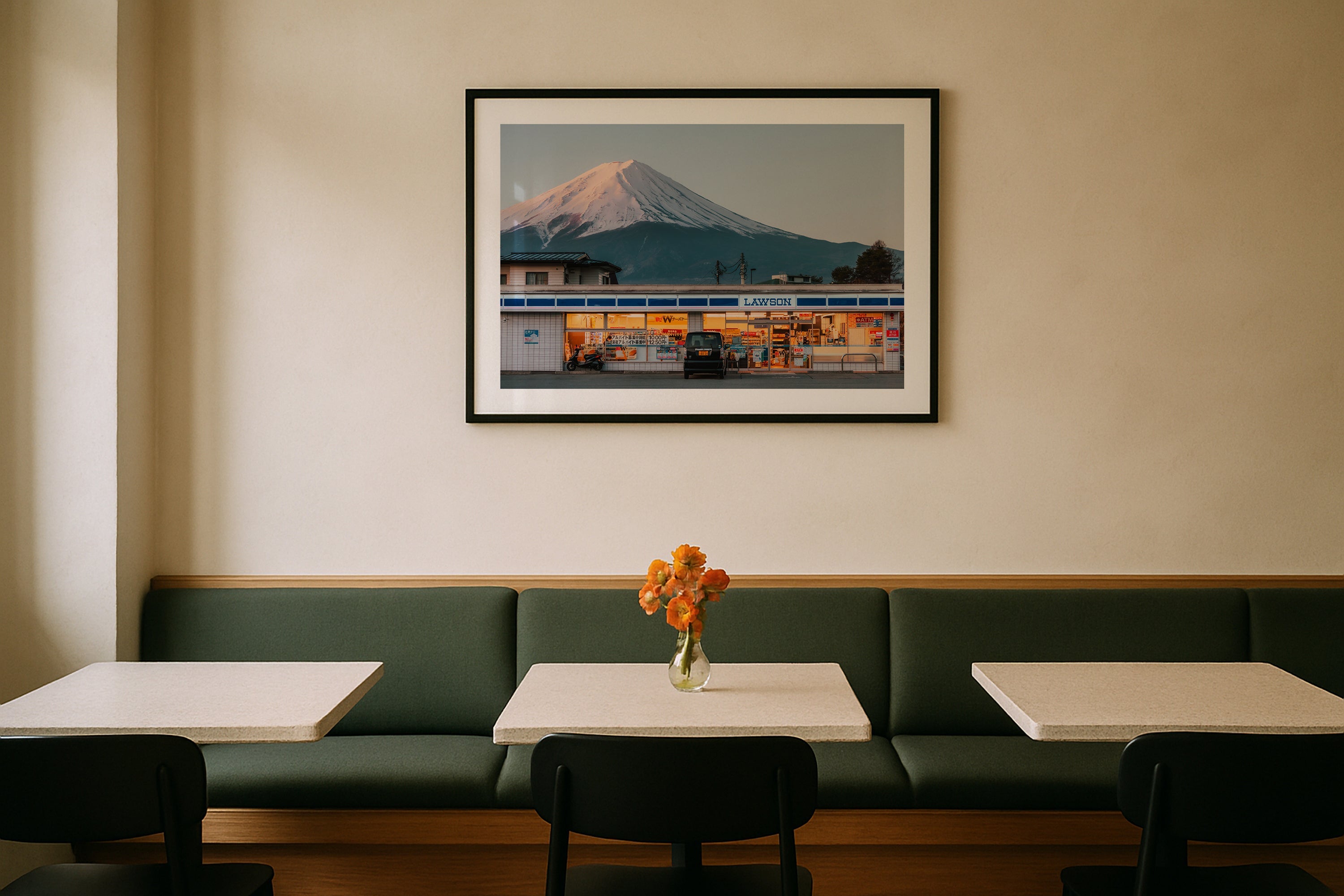
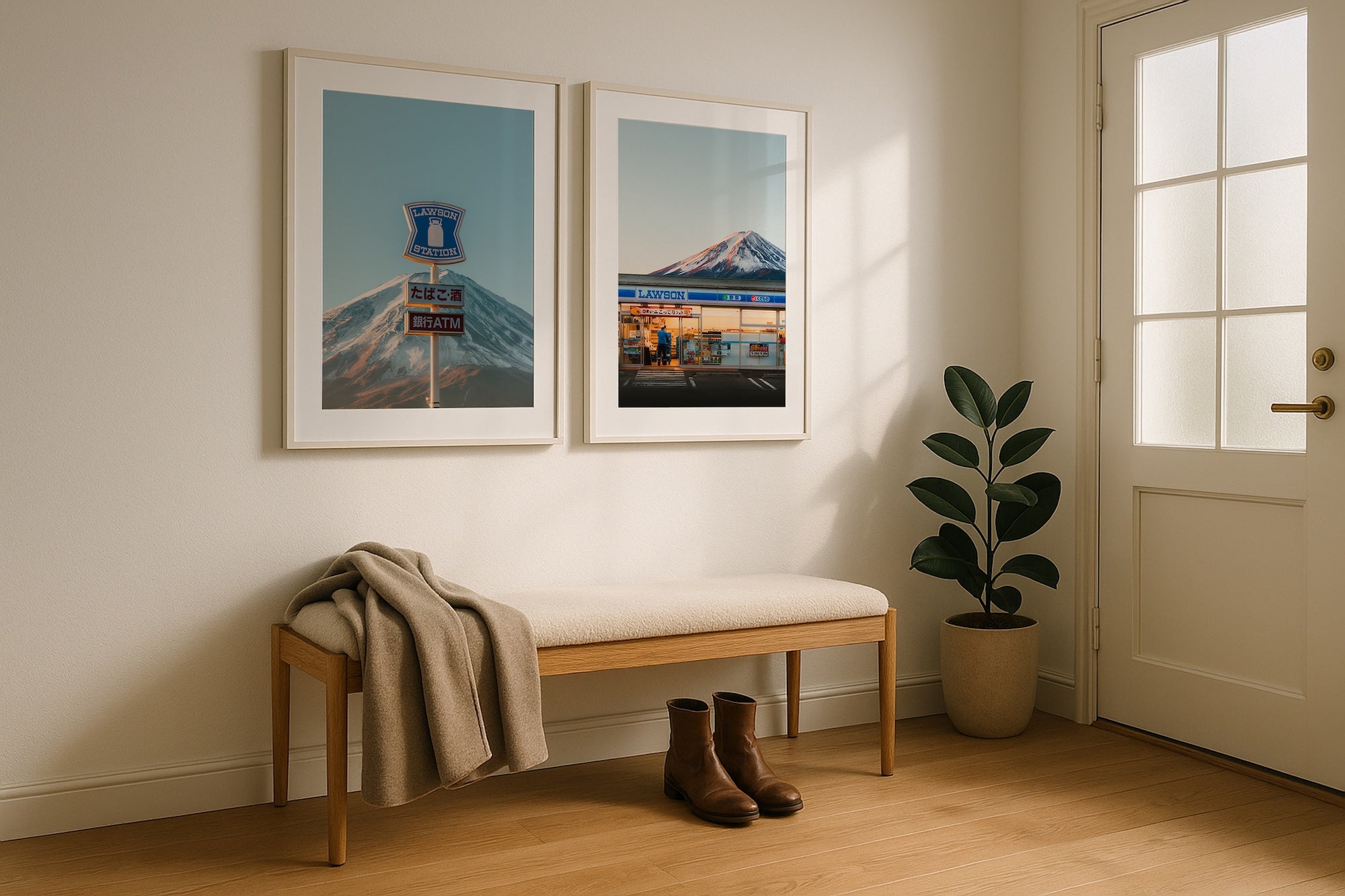
A photograph of Mount Fuji might remind you of a trip through Japan.
A Melbourne cityscape might represent the place you grew up.
An aerial photograph of Bondi might have nothing to do with memory at all. You might simply love the colours and shapes.
That's enough.


View Melbourne Albert Park Sunset →

View Bondi Icebergs Pool From Above →
The most interesting homes rarely look as though every object was selected from the same catalogue. They contain things that say something about the people living there.
Wall art is one of the easiest ways to introduce that personality.
Explore original framed photography prints →
Art can hold a memory of a place
Travel photography has an unusual ability to bring a place back into everyday life.
A photograph can remind you of the atmosphere of a city, the light at a particular time of day, or a trip you haven't thought about for years.
That's why I don't think choosing travel wall art always needs to begin with interior design.
Sometimes it begins with a connection.
Maybe you spent your honeymoon on the Amalfi Coast.
Maybe you lived in London.
Maybe you travel to Japan every year.
Maybe Sydney will always feel like home.
Or perhaps there is somewhere you haven't visited yet but feel inexplicably drawn towards.
A photograph can become a small connection to that place.
When I look at some of my own photographs, I still remember what happened around the frame.
Waiting for cloud to move away from Mount Fuji.
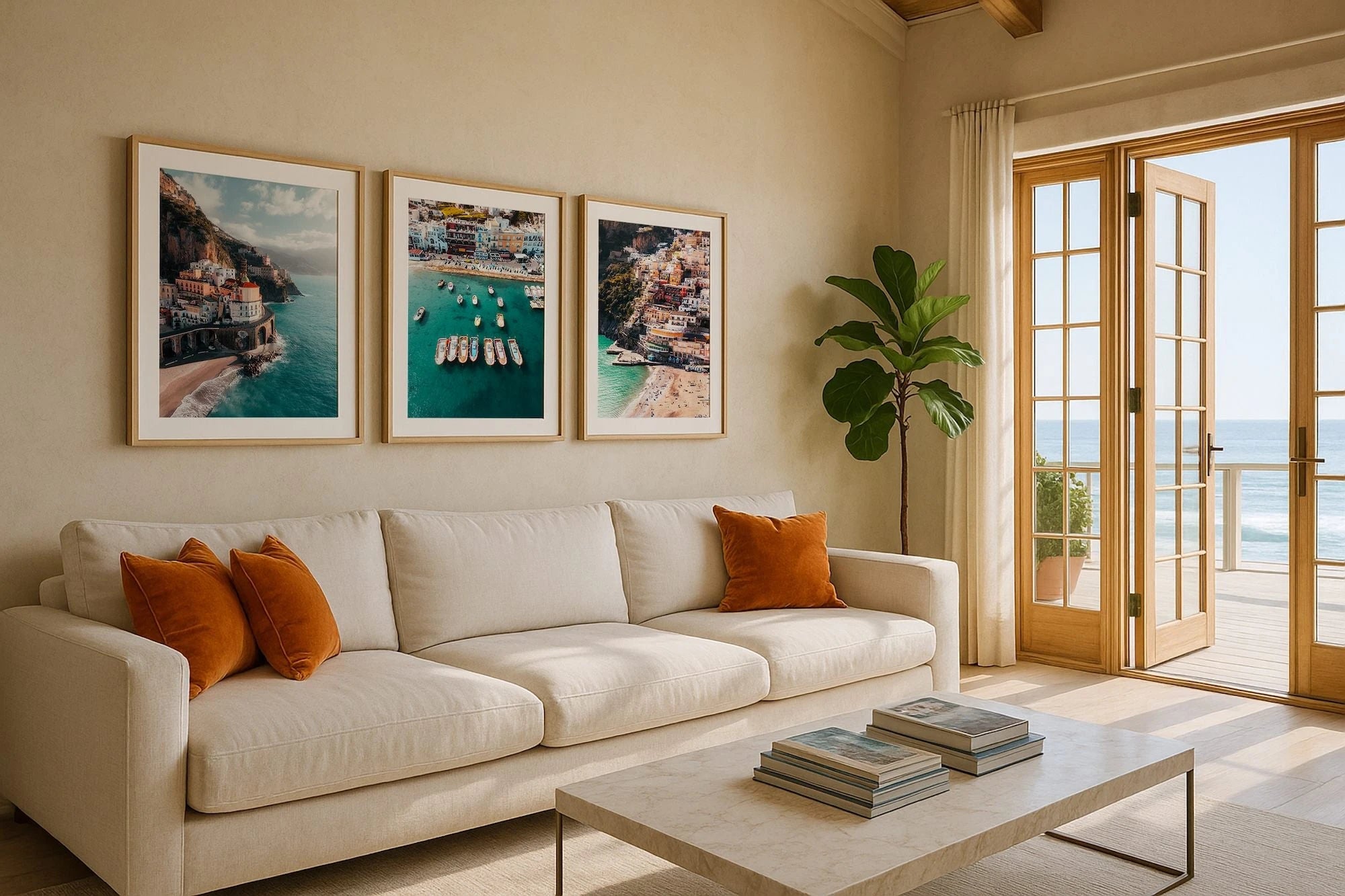
Watching the last light disappear from Positano.
Standing above Manhattan and realising how small individual buildings become when the entire city is visible.


View New York City 'Metropolis Melodies' →
The viewer won't have those exact memories.
They bring their own.
That is when a photograph stops being only a photograph of somewhere and begins meaning something different to the person who lives with it.
Explore travel photography prints →
Wall art changes the feeling of a room
Art can have a surprisingly large influence on how a room feels.
A colourful coastal photograph brings something very different into a space than a dramatic black-and-white cityscape.
Neither is better.
They simply create different atmospheres.
A photograph with a lot of open sky, water or negative space can make a room feel calmer and more expansive.
An architectural photograph can feel structured and graphic.
Warm sunset tones can soften an interior.
A large black-and-white print can create contrast without introducing another colour palette.
This is one reason I wouldn't choose art only by asking:
“Does this match my room?”
A better question might be:
“How do I want this room to feel?”
That shift makes choosing wall art much easier.
For a bedroom, you might want something quieter.
For a living room, perhaps the artwork can carry more visual weight.
For a home office, something that gives your eye somewhere to travel beyond the desk can be particularly welcome.
The room gives you clues.
The artwork doesn't need to match everything in it.
It needs to belong there.
Nature photography can bring the outside into an interior
There is also something instinctively appealing about seeing nature inside a built environment.
Ocean.
Mountains.
Trees.
Open landscapes.
Even when a photograph is hanging in the middle of a city apartment, it can introduce a visual connection with somewhere much larger and more open.
There is research behind this idea too.
A systematic review published in the International Journal of Environmental Research and Public Health examined 37 studies involving visual exposure to nature in indoor settings. Many of the studies using photographs, videos and other representations of natural scenery found physiological responses associated with greater relaxation compared with control imagery.
That doesn't mean hanging a landscape photograph on the wall is a treatment for stress, and art shouldn't be sold with that promise.
But it does help explain why natural imagery can feel so comfortable in places where we spend a lot of time.
I think there is also a much simpler explanation.
Sometimes it just feels good to look beyond four walls.
Explore nature photography prints →
Art gives the eye somewhere to go
One of the first things I notice when photographing a scene is how the eye moves through it.
Where do you look first?
Where do you go next?
Is there enough empty space?
Is something pulling your attention away from the subject?
The same idea applies once a photograph is hanging in a room.
A large blank wall offers very little for the eye to settle on.
Artwork creates a focal point.
Above a sofa, it can anchor an entire living room.
At the end of a hallway, it gives you something to move towards.
Above a bed, it can create balance.
In an open-plan home, a large framed artwork can visually define one area without adding another piece of furniture.
The artwork becomes part of the architecture of the room.
That is one reason size matters much more than people sometimes expect.
The right size can completely change the impact
A photograph you love can still feel wrong if the scale doesn't suit the wall.
One of the most common mistakes with wall art is choosing something too small for a large space.
A tiny frame floating above a wide sofa often makes both the artwork and the wall feel smaller.
The same photograph at a larger scale can completely change the room.
Details become visible.
The image has presence.
And instead of feeling like decoration added afterwards, it begins to feel intentional.
That doesn't mean bigger is always better.
A narrow hallway might suit a smaller portrait-oriented artwork.
A console can work beautifully with a medium-sized piece.
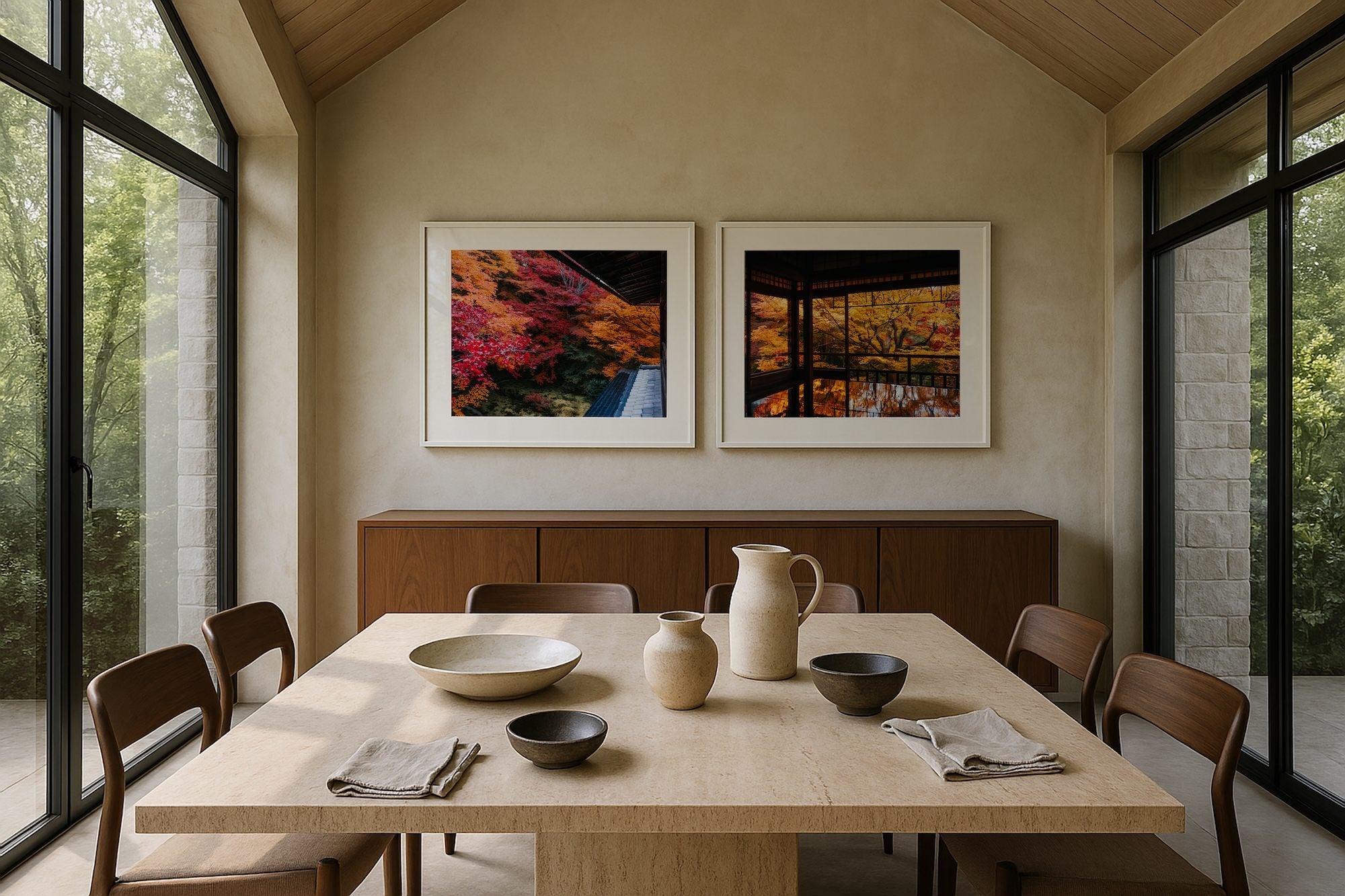
A pair of smaller photographs can sometimes work better than one enormous print.
The goal is proportion.
Before choosing a size, look at the entire wall rather than only the empty area directly in front of you.
Consider the furniture below it.
The ceiling height.
How far away you normally view the artwork.
And whether you want the piece to quietly complement the room or become its focal point.
View the wall art size guide →
Colour doesn't have to match perfectly
Another question people often have is whether wall art should match the colour of the room.
I don't think it should.
At least not perfectly.
If every colour in an artwork already exists in the cushions, rug and furniture, a room can start feeling overly coordinated.
Instead, think about relationships.
A warm photograph can sit beautifully inside a neutral room.
Blue ocean photography can create contrast against warmer timber furniture.
Black-and-white wall art can work in an interior already containing plenty of colour because it introduces structure rather than another competing palette.
Natural oak framing can soften a photograph.
A black frame can create stronger definition.
A white frame can disappear more easily into a lighter interior.
The art and the room should speak to each other.
They don't need to wear the same outfit.
Explore black and white photography prints →
Original art feels different from filling a blank space
There is an enormous amount of wall decor available now.
And if the only objective is covering an empty wall, almost anything can do that.
But I think there is a difference between filling a wall and choosing something you actually want to keep looking at.
Original photography has a story before it ever reaches the room.
Someone travelled there.
Waited for the light.
Decided where to stand.
Made hundreds of small decisions about what should and shouldn't appear inside the frame.
Then one fraction of a second became the photograph.
That doesn't mean you need to understand photography to appreciate it.
You don't need to know the camera, lens or shutter speed.
You only need to feel something when you see the image.
But knowing there was a real moment behind it can make the artwork feel less disposable.
Every photograph in the Peter Yan Studio collection began as a real place and a real moment photographed during my travels.
None of them were created simply because a particular colour happened to be trending in interiors that year.
That matters to me.
I want the photograph to still work long after the trend has changed.
Art can become a conversation
There is another reason I like having photography in a home.
People ask about it.
Where is that?
Have you been there?
What made you choose that photograph?
A photograph of somewhere recognisable can immediately start a conversation.
But sometimes the more unusual images create better ones.
An aerial ocean pool that takes a few seconds to understand.
A tiny swimmer inside a huge landscape.
A building photographed so closely that it almost becomes abstract.
A familiar landmark shown from an unfamiliar angle.

View Sydney Bronte Rock Pool Swimmer →
The artwork gives somebody something to discover.
And often the story of why you chose it becomes part of the piece.
You don't need art on every wall
I think this is important.
A home does not become better simply because every empty wall has something hanging on it.
Negative space matters in interiors for the same reason it matters in photography.
It gives everything else room.
A carefully chosen large artwork can have far more impact than six pieces added simply because there was space available.
Some walls should stay empty.
Some photographs need space around them.
The goal isn't to collect wall art until there are no walls left.
It's to choose the places where art actually adds something.
How do you choose wall art you'll still love years from now?
Trends are useful for discovering ideas, but I wouldn't use them as the main reason to buy art.
Before choosing a photograph, I'd ask three simple questions.
Would I still want to look at this if I changed my furniture?
If the answer is yes, you're probably choosing the photograph rather than the current interior trend.
Does the image make me feel or remember something?
That connection doesn't need to be profound. Sometimes you simply love looking at a particular colour, landscape or composition.
Is the scale right for where it will live?
A great photograph can lose its impact when it's much too small for the wall.
If those three things work, frame colour, cushions and everything else become much easier to solve.
Wall art should mean something to the person living with it
Ultimately, that is why I think wall art matters.
It isn't essential in the practical sense.
A home still functions without it.
But homes aren't only practical spaces.
They are where we spend an enormous part of our lives.
They hold memories, routines, people and objects we've chosen to keep around us.
Art becomes part of that environment.
Sometimes it creates colour.
Sometimes it completes a room.
Sometimes it reminds you of somewhere on the other side of the world.
Sometimes you don't have a complicated explanation at all.
You just like looking at it.
That may be the best reason of all.
Explore the complete Peter Yan Studio framed photography collection →


1 comment
Love it!