


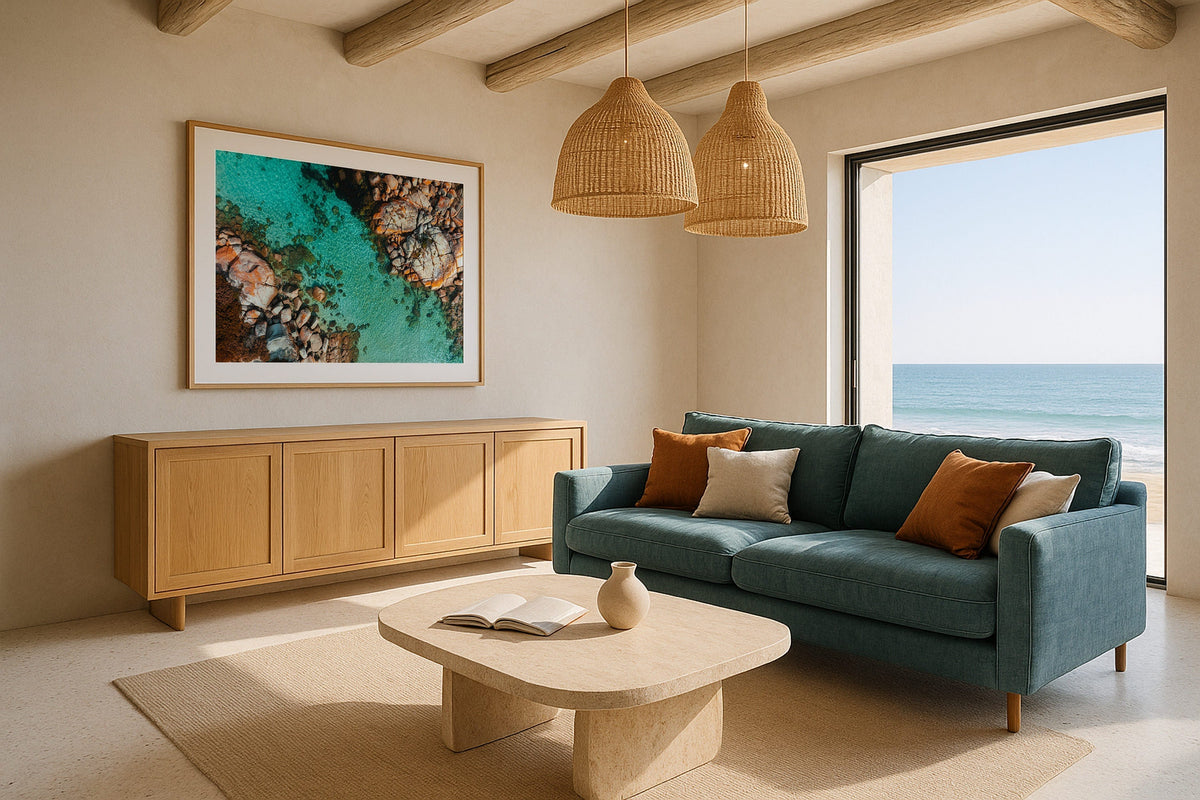
Australia is difficult to photograph as one place.
The distances are too large.
The landscapes change too quickly.
A photograph made in the centre of Melbourne can have almost nothing visually in common with one made on the coast of Tasmania or above the red earth of Western Australia.
Even the ocean changes.
Around Sydney, it crashes into rock pools and sandstone cliffs.
In Western Australia, the colour can shift from deep blue to turquoise within the same stretch of coastline.
Further south, the Great Ocean Road feels darker and more rugged.
Then there are the cities.
Melbourne.
Sydney.
Perth.
Each recognisably Australian, but none particularly similar to the other.
Maybe that is what I like most about photographing Australia.
Every time you think you understand what the country looks like, you travel far enough and it changes again.
Melbourne is the Australia I know most closely
Melbourne is different for me because I don't really approach it as a destination.
It is familiar.
That changes the way I photograph it.
There isn't the same pressure to arrive, find the famous viewpoint and make the photograph before leaving.
I can return.
Wait for different weather.
Notice something from another angle.
Or see a place I've passed many times and suddenly realise there is a photograph there.
The MCG from above
The Melbourne Cricket Ground is one of the subjects I keep returning to.
From street level, the MCG is enormous.
From above, its relationship with the city becomes much more interesting.
The stadium becomes an almost perfect geometric shape surrounded by parkland, roads and Melbourne's skyline.
In Melbourne Cricket Ground MCG Aerial, the photograph isn't only about sport.
It is about where the MCG sits within Melbourne.

View Melbourne Cricket Ground MCG Aerial →
That is something aerial photography often gives me.
Instead of simply showing what a place looks like, it shows how it belongs to everything around it.
Melbourne beyond the obvious landmarks
Albert Park gives me a completely different version of the city.
Water sits in the foreground while the skyline rises behind it.
In Melbourne Albert Park Sunset, the city catches the last warm light while the lake gives the composition enough space to breathe.

View Melbourne Albert Park Sunset →
It doesn't feel like a traditional Melbourne skyline photograph.
And I like that.
Sometimes a city becomes more interesting when its most recognisable buildings aren't the only thing you see.
A body of water.
A row of palm trees.
A road curving through the foreground.
Those smaller elements can say just as much about a place.
Explore the Melbourne photography collection →
Sydney feels completely different
Sydney announces itself much more immediately.
The harbour does a lot of the work.
The Opera House.
Harbour Bridge.
Ferries.
Sailing boats.
Water running through the centre of the city.
There aren't many skylines where two pieces of architecture have become so strongly connected with the identity of a place.
But what interests me about photographing Sydney isn't simply recording those landmarks.
It is working out how much of them you actually need to show.
You don't need the whole Opera House
In Sydney Opera House 'Hide & Seek', only part of the building is revealed between the architecture around it.

View Sydney Opera House 'Hide & Seek' →
I like photographs that make something familiar slightly less immediate.
Everyone knows what the Opera House looks like.
That gives you permission to show less.
A section of the sails can be enough.
A reflection can be enough.
A view through another building can be enough.
Sometimes recognition happens more strongly when the subject isn't handed to you completely.
The harbour from above
The same thing happens with the Harbour Bridge.
From the ground, it dominates.
From above, it becomes one piece of a much larger landscape.
In Sydney Harbour Bridge From Above Black & White, removing colour makes the bridge, roads, harbour and surrounding city much more graphic.

View Sydney Harbour Bridge From Above Black & White →
Sydney becomes lines.
Curves.
Water.
Architecture.
The familiar landmark is still there, but you start understanding its relationship with the harbour rather than only recognising the bridge itself.
Explore the Sydney photography collection →
Then Sydney leaves the harbour behind
One of the things I like most about photographing Sydney is how quickly its visual identity changes when you move towards the coast.
Suddenly there is no Opera House.
No Harbour Bridge.
No skyline.
Instead there are beaches, sandstone, waves and ocean pools.
Yet these photographs can still feel unmistakably Sydney.
Bondi.
Bronte.
Coogee.
Mona Vale.
The ocean becomes just as important to the city's identity as its architecture.
The geometry of Sydney's ocean pools
From above, Sydney's rock pools become some of the most graphic subjects on the Australian coastline.
The architecture is controlled.
Straight lines.
Lane markings.
Concrete edges.
Then immediately beside it is the Pacific Ocean doing whatever it wants.
In Bondi Icebergs Pool From Above, that contrast becomes the entire photograph.

View Bondi Icebergs Pool From Above →
There is order inside the pool.
Movement outside it.
A wave arrives and, for a moment, the boundary between the two disappears.
I keep photographing these pools because the structure remains almost unchanged while the ocean keeps redesigning the scene around it.
Explore the Sydney Ocean Pools collection →
The Great Ocean Road is a different kind of coast
Travel south-west from Melbourne and the coastline becomes harder.
More exposed.
Less urban.
The Great Ocean Road is often photographed through its famous landmarks, particularly the Twelve Apostles.
They deserve the attention.
But what interests me about this coastline is the scale around them.
The cliffs.
The open ocean.
The amount of space.
The Twelve Apostles
In 12 Apostles Great Ocean Road, the limestone formations become small compared with the water and coastline around them.

View 12 Apostles Great Ocean Road →
That is important.
If you photograph only the rock formations, you show what they look like.
Give them enough surrounding landscape and you begin to show what it feels like to stand there.
Aerial photography exaggerates that scale even further.
From above, the edge of Australia becomes incredibly clear.
Land simply stops.
Ocean begins.
Sometimes the coastline is enough
Not every Australian landscape needs an identifiable landmark.
Golden Shoreline, Great Ocean Road is much more about the relationship between waves, sand and light.
There isn't necessarily one object your eye needs to recognise.
The coastline itself becomes the subject.

View Golden Shoreline, Great Ocean Road →
I think photographs like this matter within an Australian collection.
Australia is known for particular landmarks.
But most of the country doesn't look like a landmark.
Sometimes it is simply an empty coastline stretching further than you expected.
And that can be just as recognisable.
Tasmania feels quieter
Tasmania gives me another completely different version of Australia.
The landscapes feel more contained.
The air, weather and colour can feel different from the mainland.
And there are places where the landscape seems to ask for less in the frame rather than more.
Wineglass Bay at sunrise
Wineglass Bay Sunrise, Tasmania is one of those photographs where the shape of the landscape does most of the work.
The bay curves through the frame while the surrounding hills separate it from everything beyond.

View Wineglass Bay Sunrise, Tasmania →
Early light keeps the colours soft.
Nothing needs to be particularly dramatic.
The geography is enough.
Bay of Fires from above
The Bay of Fires changes the palette again.
Orange-coloured rocks sit against clear blue water and pale sand.
From above, those colours separate naturally.
In Bay Of Fires Tasmania I, the coastline becomes almost abstract.

View Bay Of Fires Tasmania I →
Rock.
Water.
Sand.
There isn't much else required.
This is one of the things aerial photography keeps teaching me.
Moving higher often removes information.
And sometimes removing information makes the photograph stronger.
Your eye stops looking for a landmark and starts responding to shape and colour.
Explore the Tasmania photography collection →
Western Australia changes the scale again
Western Australia feels enormous in a way that is difficult to communicate until you travel through it.
Perth can feel calm and ordered.
Rottnest Island is surrounded by clear water and pale beaches.
Travel further north and suddenly there is red earth meeting turquoise ocean.
The palette changes completely.
The distances become much more obvious.
The Western Australia collection stretches across Perth, Rottnest Island, Cottesloe and the Broome/James Price Point coastline.
The Blue Boathouse
Perth Blue Boathouse is almost the opposite of the larger Australian landscapes.
It is very simple.
One blue building.
One jetty.
Water.
Sky.

Sometimes simplicity is much harder to find than complexity.
There are no mountains.
No dense city.
No dramatic coastline competing for attention.
Your eye knows exactly where to go.
The long jetty leads directly towards the small blue building.
That simplicity is part of what makes the photograph work particularly well on a wall.
It doesn't need to explain an entire destination.
One structure can be enough.
Rottnest from above
Rottnest Island is much more about colour.
At places such as Salmon Bay, the water can shift through several shades of blue and turquoise before reaching the sand.
From above, people and boats become tiny.
The colour becomes the photograph.
In Salmon Bay, Rottnest Island, Western Australia V, the coastline is reduced to a series of shapes and tones.

View Salmon Bay, Rottnest Island, Western Australia V →
This is a very different Australia from Melbourne or Sydney.
There are no buildings required.
No skyline.
Almost no architecture.
Just water, sand and scale.
Then the earth turns red
Travel further north through Western Australia and the palette changes again.
Around Broome and James Price Point, red and orange earth can sit immediately beside intensely coloured water.
That contrast is difficult to ignore.
In photographs such as Crocodiles of Broome: Red Earth, the Australian landscape becomes almost graphic from the air.

View Crocodiles of Broome: Red Earth →
Red land.
Turquoise water.
Very little transition between them.
It almost looks exaggerated.
But there are places in Australia where the natural colour does most of the work for you.
The challenge is not making it more dramatic.
It is knowing when to leave it alone.
James Price Point
The James Price Point coastline gives that colour even more space.
From above, enormous sections of red land meet blue ocean with very little human interruption.
Coastal Western Australia – James Price Point I is one of those photographs where distance is part of the subject.

View Coastal Western Australia – James Price Point I →
There is a lot of nothing.
And in Australia, that matters.
Some of the most memorable parts of travelling through the country aren't places where everything is happening.
They are the stretches between them.
The road.
The coast.
The horizon.
The feeling that there is far more landscape than there are people.
Explore the Western Australia photography collection →
Australia makes more sense from above
Looking through the Australian collection, aerial photography appears again and again.
There is a reason for that.
Australia is about scale.
Aerial photography is very good at showing scale.
It can reveal the shape of a city.
The curve of a coastline.
The strange position of an ocean pool.
The relationship between red earth and turquoise water.
Or how tiny a person becomes inside an enormous landscape.
From the ground, you experience a place.
From above, you often understand it.
That doesn't mean the aerial view is always better.
It simply answers a different question.
The human details still matter
For all the scale of Australia, some photographs work because of something very small.
One swimmer in a rock pool.
A boat surrounded by water.
A car travelling through the landscape.
A stadium filled with people.
A tiny building at the end of a jetty.
These objects give the landscape scale.
Without them, an aerial photograph can become completely abstract.
Add one recognisable object and suddenly your brain understands how enormous everything around it is.
That relationship between a small human detail and a huge Australian landscape is something I find myself looking for constantly.
Australia in colour and black and white
Australia is an obvious country to photograph in colour.
The blue coast.
Red earth.
Green landscape.
Bright city light.
Golden beaches.
But some of the Australian photographs I like most are black and white.
The MCG.
Sydney Harbour.
The Opera House.
The Melbourne skyline.
Removing colour shifts the attention towards architecture, shape and contrast.
It also proves something useful.
Australia isn't visually interesting only because the colours are beautiful.
Sometimes the structure underneath them is enough.
Cities and landscapes don't need separate collections in my head
There is often a distinction between being a landscape photographer and a city photographer.
I've never found that particularly useful.
Aerial photography makes the boundary even less obvious.
A city can become a landscape.
A road can become a line through a photograph.
Buildings can become texture.
A coastline can feel architectural.
An ocean pool can be both structure and nature.
Australia gives me all of those things.
Sometimes within the same day.
Why I keep photographing Australia
When you travel overseas, there is often a heightened awareness that comes from being somewhere unfamiliar.
You notice everything.
At home, it is easier to stop looking.
That can be dangerous for a photographer.
Australia has reminded me repeatedly that familiarity doesn't mean there is nothing left to photograph.
Sometimes it means you need to look harder.
There are photographs close to home.
There are photographs thousands of kilometres away without leaving the country.
There are familiar landmarks worth returning to.
And enormous parts of Australia I still haven't photographed enough.
That incompleteness is probably a good thing.
I don't think I want an Australian collection that feels finished.
Which Australian photograph works best in your space?
With more than a hundred Australian works in the collection, I wouldn't start by asking which city you prefer. I'd start with the feeling you want in the room.
For architecture and urban interiors, Melbourne and Sydney offer cleaner lines, cityscapes and strong black-and-white options.
If you want something unmistakably Australian but less urban, the Sydney ocean pools combine coastal colour with graphic geometry.
For a calmer interior, Tasmania and parts of Western Australia offer much more negative space, softer landscapes and photographs where nature dominates.
If you want strong colour, Rottnest Island, Broome and James Price Point bring some of the most intense blues, turquoise water and warm earth tones in the Australian collection.
The Great Ocean Road sits somewhere in between: dramatic coastline, but with a more rugged and restrained palette.
And for a large statement piece, aerial photographs often work particularly well because the additional size allows small details and patterns to reveal themselves gradually.
There isn't one Australian aesthetic.
That is exactly what makes choosing one interesting.
From Australia to your wall
The Australia photography collection brings together original photographs from Melbourne, Sydney, the New South Wales coastline, Victoria's Great Ocean Road, Tasmania and Western Australia.
The current collection contains more than 100 photographs, ranging from city and architectural work to aerial landscapes, ocean pools, beaches and black-and-white photography.
Every piece is available as a made-to-order framed artwork, printed using archival materials and hand-framed in Australia.
There is something particularly satisfying about that.
An Australian landscape.
Photographed here.
Printed here.
Framed here.
Eventually hanging in another part of the same country.
Looking through all of these photographs together, I don't think there is one image that explains Australia.
There shouldn't be.
The country is too large.
The distance between places is too great.
The landscapes change too much.
One photograph can show a piece of it.
Then you travel further.
And Australia becomes something else again.
If you are choosing a framed print for an Australian home, start with our featured framed photography prints, then the short guides for Melbourne photography prints for home and office and Sydney photography prints for home and apartment. Or browse black and white photography prints for the home, and where to buy original photography art in Australia.