


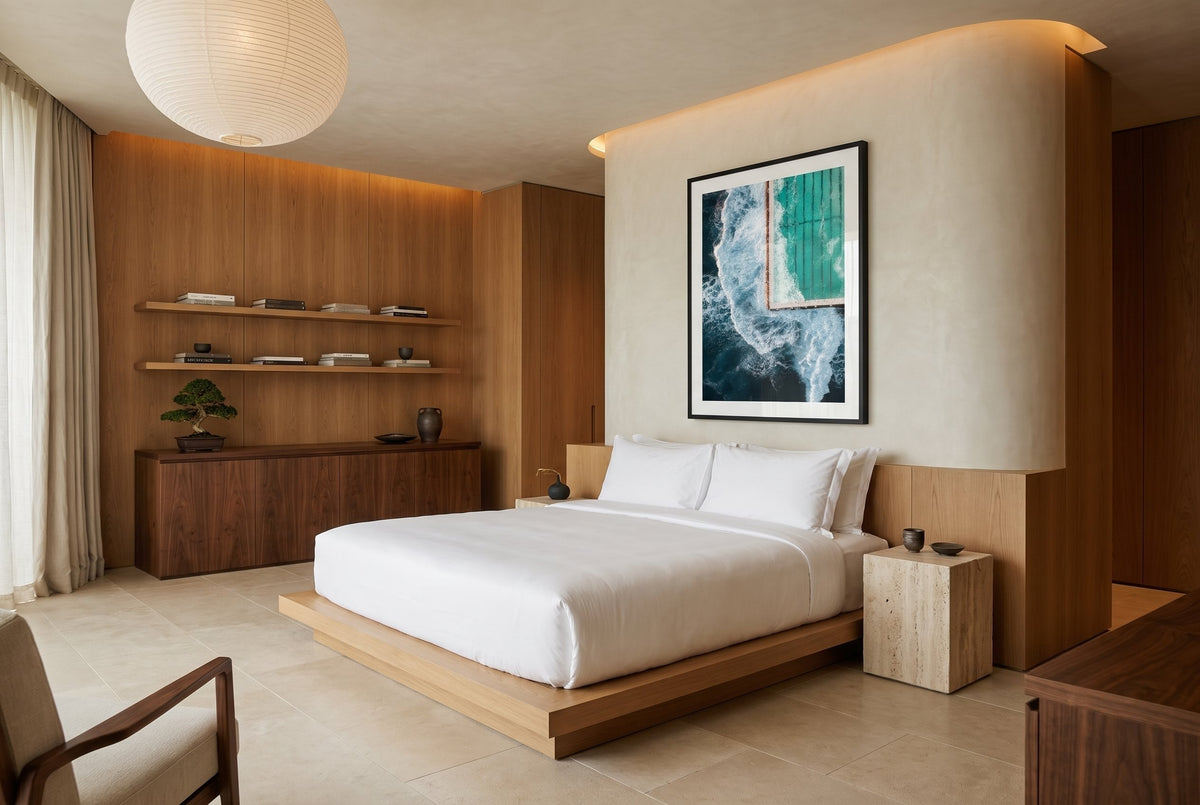
Sydney's ocean pools sit in a strange position.
They are part swimming pool, part coastline.
Straight concrete walls are built into irregular rock platforms. Lane markings disappear beneath salt water. Waves break over edges that look completely still a few seconds earlier.
From the ground, they are places to swim.
From above, they become something else.
Geometry against nature.
That contrast is what first made me want to photograph them.
The line between pool and ocean
Most swimming pools are designed to keep the outside world out.
Sydney's ocean pools do almost the opposite.
The ocean is always present.
You can see it over the edge.
Hear it.
Feel the water moving.
And when the swell is large enough, it comes directly into the pool.
That relationship makes them completely different to photograph from an ordinary swimming pool.
There is no clean separation between architecture and landscape.
The pool belongs to the coastline.
Why they work so well from above
At ground level, the experience is about the water.
From above, the shape becomes more important.
A rectangle.
A curve.
A series of lane lines.
Concrete sitting against rock.
Then beyond that structure is the ocean, which has no interest in following any of those lines.
Aerial photography exaggerates that contrast.
The pool becomes almost perfectly organised.
The sea becomes movement.
That is why so many of my Sydney ocean pool photographs were made from above.
You stop seeing only a place to swim.
You start seeing a composition.
Bondi Icebergs
Bondi Icebergs is probably the most recognisable ocean pool in Sydney.
The 50-metre pool sits at the southern end of Bondi Beach, directly against the Pacific Ocean.
It has been photographed countless times.
And like any famous location, that creates a challenge.
The pool is already beautiful.
The coastline is already dramatic.
The question is what happens within the frame that makes one moment different from another.
Bondi Icebergs Pool From Above
From directly above, almost everything we normally associate with Bondi disappears.
The beach becomes less important.
The surrounding buildings disappear.
Even the horizon is gone.
What remains is water, concrete, swimmers and waves.
That is what I like about Bondi Icebergs Pool From Above FP1.

View Bondi Icebergs Pool From Above FP1 →
The lane markings provide order.
Swimmers become tiny human details.
And outside the pool, the ocean is doing something completely different.
It is one of those photographs where moving the camera higher makes the subject simpler rather than more complicated.
Waiting for the wave
The pool itself doesn't move very much.
The ocean does.
That means the composition can be ready long before the photograph is.
Sometimes I am waiting for a wave to arrive.
Too small and the edge between pool and sea feels static.
Too large and the white water can overwhelm everything else.
Then one wave arrives at exactly the right point.
It breaks against the pool.
White water moves through the frame.
For a fraction of a second, the geometry and chaos meet.
That is the moment.
Bondi Icebergs Splash
Bondi Icebergs Splash is much more about that interaction than the pool itself.
The wave is what gives the photograph energy.

A second earlier, the composition is mostly architecture.
A second later, the water has already changed shape.
I like photographs that depend on timing like this.
The location might exist for decades.
The photograph exists for less than a second.
Bondi on a summer day
The character of the pools also changes with the people using them.
On a bright summer day, Bondi Icebergs becomes busy.
Swimmers fill the lanes.
People gather around the edges.
The blue of the water becomes much more intense under strong Australian light.
In Bondi Beach Icebergs Pool Summer Day II, that activity becomes part of the photograph.

View Bondi Beach Icebergs Pool Summer Day II →
I don't necessarily want to remove the people.
They provide scale.
Without swimmers, it is easy to forget how large the pool actually is.
From high enough above, each person becomes only a small mark within the composition.
The architecture remains dominant, but the photograph still feels lived in.
Early morning feels completely different
Go back earlier in the day and Bondi changes.
The light is softer.
There are fewer people.
The coastline can feel much quieter than the Bondi most visitors associate with summer afternoons.
That is what interests me in Bondi Beach Icebergs Morning I.

View Bondi Beach Icebergs Morning I →
The subject is exactly the same pool.
But the photograph asks for a different feeling.
Less energy.
More space.
More emphasis on the relationship between water and rock.
This is why I don't think photographing a famous location once is necessarily enough.
Places change with light, weather, tide and people.
Sometimes the better photograph happens when you return.
Bronte feels more contained
Move south along the coast and Bronte has a completely different shape.
The ocean-fed lap pool is tucked beneath the southern headland, protected by the surrounding rocks. Bronte's baths have a long history too: the council traces their construction to 1887, and the pool remains an ocean-fed community swimming space today.
Photographically, what interests me is how naturally the pool seems to fit into the landscape.
Bondi Icebergs feels bold.
Bronte feels almost carved into the coast.
One swimmer changes everything
Sydney Bronte Rock Pool Swimmer is one of my favourite examples of why a person can completely change an aerial photograph.
From above, the pool has a strong shape.
Lane lines run through clear water.
Rocks and white waves surround the edge.
That could already be the photograph.
Then there is one swimmer.

View Sydney Bronte Rock Pool Swimmer →
Suddenly the pool has scale.
Your eye has somewhere to begin.
The swimmer is tiny, but that small human presence explains everything around it.
This happens repeatedly in landscape photography.
A mountain can feel large.
Add one person and it becomes enormous.
The same thing happens here.
The swimmer makes the coastline bigger.
The ocean doesn't respect the edge
What I particularly like about Bronte is the point where the pool ends.
There is a clear constructed boundary.
Then immediately beyond it are rocks and waves.
From above, there is almost no transition.
Order.
Then chaos.
The water inside the pool is relatively calm.
Only metres away, the same ocean is breaking against rock.
That contrast is what gives the photograph tension.
Without the ocean, it would simply be a swimming pool.
Without the pool, it would simply be coastline.
The image needs both.
Coogee and the colour of the rock
Coogee introduces another element.
The rock itself becomes much more prominent.
In Coogee Beach Rock Pool, the warm orange-brown coastal rock sits beside blue-green water.

The pool occupies only part of the composition.
Around it, waves break through an irregular landscape of rock.
That colour relationship is what initially catches my eye.
Warm land.
Cool water.
White foam separating them.
It is naturally graphic without needing very much manipulation.
The aerial perspective simply makes the boundaries clearer.
Sydney's swimming culture is built into the coastline
These pools aren't decorative additions to Sydney's beaches.
They are working public spaces.
People swim laps before work.
Children learn to swim.
Locals return throughout the year.
And many of the pools have been part of the coastline for generations.
Ocean pools are a distinctive feature of the New South Wales coast. The NSW Government notes that there are around 100 along the state's coastline, with many constructed as public works projects during the Depression era, although a number of Sydney's pools date even earlier.
That history adds something to the photographs for me.
These aren't structures placed beside the sea purely because they look good.
They exist because people wanted a way to swim with the ocean while having some protection from it.
The beauty came from the function.
Mona Vale almost floats
Mona Vale is perhaps the clearest example of how strange an ocean pool can look from above.
The pools sit on a sand spit at the northern end of Mona Vale Beach. At high tide, water can surround them in a way that makes the structure appear almost detached from the land.
That creates a photograph that feels very different from Bondi or Bronte.
Mona Vale Rock Pool I
In Mona Vale Rock Pool I, the pool is surrounded by an enormous amount of natural texture.
Rock.
White water.
Deep blue ocean.
Sand.
Then, sitting inside all of it, is this small rectangular piece of turquoise water.

The pool almost looks too precise for the landscape around it.
That is exactly why it works.
Nature rarely gives you perfect rectangles.
People do.
Moving further away
Mona Vale Rock Pool II changes the relationship again.
Rather than concentrating only on the pool, a wider aerial perspective gives more room to the coastline.

This is something I think about often when photographing from above.
How much context does the subject need?
Move closer and the pool becomes graphic.
Move further away and you understand where it exists.
Neither photograph is necessarily better.
One is about shape.
The other is about place.
The colour isn't always blue
When people think about Australian coastal photography, there is an obvious expectation.
Blue water.
Bright sunshine.
White sand.
Those colours are beautiful, and they are genuinely part of the coastline.
But the photographs become more interesting when you start noticing everything around the blue.
Rust-coloured rocks.
Dark sections of deep water.
Green areas inside a pool.
White foam.
Human skin.
Concrete.
Shadows.
The ocean isn't one colour.
Neither are the pools.
That variation is part of why these photographs can work so strongly as wall art.
The subject is coastal, but the palette can be surprisingly complex.
The tide keeps redesigning the photograph
Unlike photographing a building, the scene around an ocean pool never stays exactly the same.
The tide changes.
The swell changes.
Wind changes the surface.
Cloud changes the colour.
The number of swimmers changes.
Even the amount of white water around the rocks can completely alter the balance of the frame.
That means returning to the exact same coordinates doesn't guarantee the same photograph.
I like that.
The architecture provides something predictable.
The ocean refuses to cooperate.
Somewhere between the two is the image.
Why aerial photography makes these pools almost abstract
There is another reason I enjoy photographing them from above.
Perspective removes context.
If I photograph Bondi Icebergs from the beach, you immediately recognise a pool beside the ocean.
From directly overhead, the image can take a second longer to understand.
Lines.
Blocks of colour.
Tiny people.
White shapes entering the frame.
It can become almost abstract before you realise what you're looking at.
Those are often the photographs I find most interesting on a wall.
You don't understand everything immediately.
The image works first as shape and colour.
Then the subject reveals itself.
They are very Sydney without showing the Sydney skyline
This is perhaps what I like most about the series.
There is no Opera House.
No Harbour Bridge.
No skyline.
Yet the photographs still feel strongly connected to Sydney.
That says something about how much of Sydney's identity exists away from the harbour.
The beaches.
The coastal walk.
Morning swims.
Rock platforms.
Salt water.
The relationship people here have with the ocean.
A destination doesn't always need its most famous landmark to be recognisable.
Sometimes everyday culture says more.
Photographing Sydney differently
When I photograph Sydney Harbour, I am usually thinking about architecture.
Lines.
Buildings.
Bridges.
Light across the water.
The ocean pools ask for something different.
They are smaller subjects inside much larger landscapes.
That means the photograph often comes from balance.
How much pool?
How much ocean?
How much rock?
Do I include swimmers?
Do I wait for the wave?
Do I show the entire structure or only part of it?
The simplicity of the subject creates a surprising number of decisions.
Maybe that is why I keep coming back to them.
Which Sydney ocean pool photograph works best in your space?
The ocean pool collection is visually consistent enough to work as a series, but the individual photographs have very different personalities.
If you want the most recognisable Sydney coastal subject, Bondi Icebergs Pool From Above FP1 is the natural starting point. Its geometry and blue water make it immediately graphic.
For more energy, Bondi Icebergs Splash puts greater emphasis on the ocean itself and the moment a wave meets the pool.
Sydney Bronte Rock Pool Swimmer feels more intimate. The single swimmer creates a human focal point while the surrounding rocks and water provide scale.
Coogee Beach Rock Pool brings warmer coastal tones into the composition, making it particularly suited to interiors with natural timber and warmer neutral colours.
And the Mona Vale Rock Pool photographs feel more landscape-driven. The pool is smaller within the scene, allowing the coastline and ocean to become just as important.
If you're hanging several works together, I also think ocean pool photographs lend themselves particularly well to pairs or sets.
The repeated idea connects them.
The different shapes keep them from feeling repetitive.
From Sydney's ocean pools to your wall
The Sydney ocean pool collection includes original aerial photographs from Bondi, Bronte, Coogee and Mona Vale, capturing the meeting point between architecture and the Pacific coastline. The current dedicated collection contains 12 framed works.
Each photograph is available as a made-to-order framed artwork, printed using archival materials and hand-framed in Australia.
The collection moves between clean geometric compositions, swimmers, breaking waves and wider coastal landscapes.
Looking through these photographs now, I think the thing that keeps attracting me to Sydney's ocean pools is actually very simple.
Someone drew a line and said:
The pool ends here.
The ocean never agreed.
And that tension between the two is where the photographs happen.
If you are choosing Sydney framed photography for a home or apartment — harbour, Opera House, Bondi, or ocean pools — start with our calm buying guide: Sydney photography prints for home and apartment.