


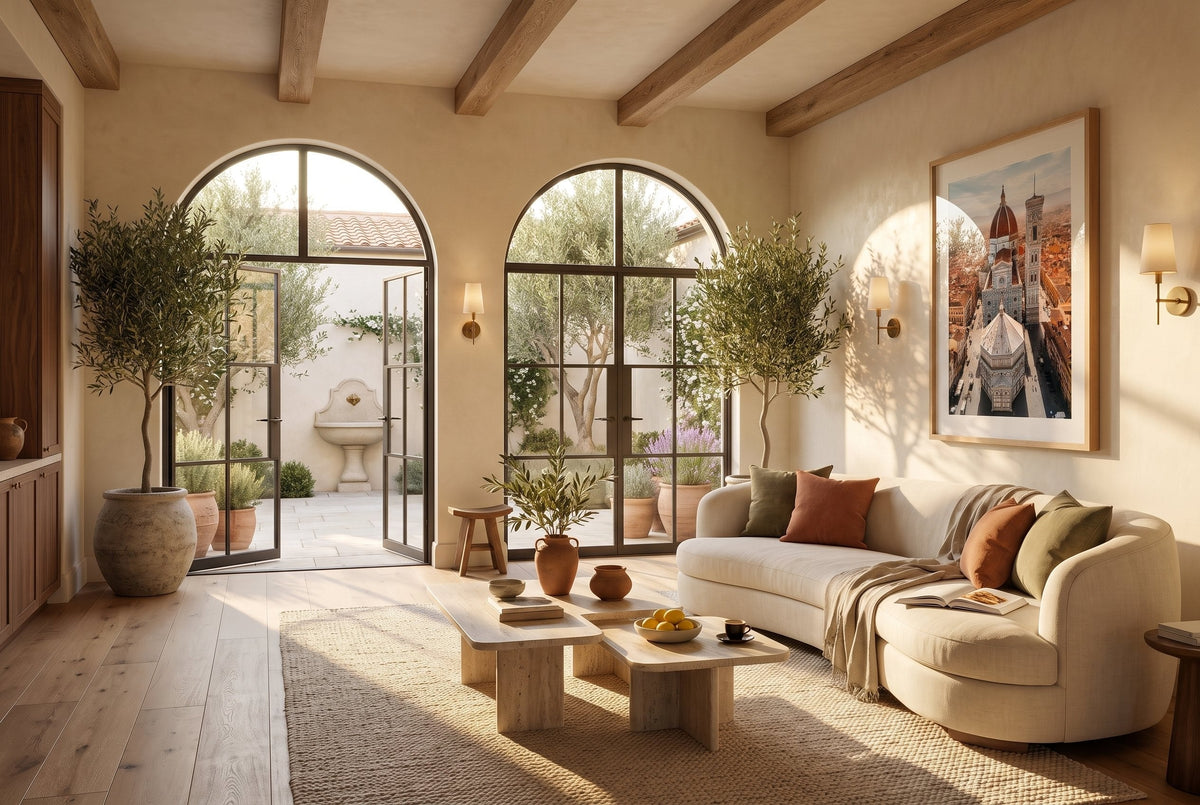
There are cities where you can walk for hours without one building dominating the view.
Florence isn't one of them.
The Duomo keeps finding you.
It appears at the end of a narrow street.
Above a row of terracotta rooftops.
Between buildings.
From a hill in the distance.
And once you get above Florence, it becomes almost impossible to look anywhere else.
That enormous red dome seems to organise the entire city around it.
I photographed it more than once.
Then again.
And again.
Normally I would worry about repeating the same subject.
In Florence, repetition became the point.
The cathedral barely changes.
Everything around it does.
The first thing you notice is the dome
The Cathedral of Santa Maria del Fiore is difficult to understand properly from ground level.
When you stand beside it, the scale is almost too large.
You see marble.
Doors.
Windows.
People.
Giotto's Campanile rising beside you.
And if you look upwards, Brunelleschi's dome seems to occupy most of the sky.
It is impressive, but you are almost too close to understand what you are looking at.
Move away and something interesting happens.
The cathedral begins belonging to Florence.
The surrounding rooftops appear.
The streets become visible.
Other churches and towers enter the landscape.
And the dome still rises above almost everything.
That relationship interested me much more than photographing the building in isolation.
Florence from above
Aerial photography completely changes the way Florence makes sense.
At street level, the historic centre feels dense and sometimes almost maze-like.
From above, there is suddenly order.
Terracotta rooftops repeat across the city.
Streets cut between them.
Piazzas create small openings.
Then the Duomo breaks the pattern completely.
Florence's Duomo and Baptistery from Above
In Florence's Duomo and Baptistery from Above, the cathedral occupies the centre of a much larger field of architecture.
The Baptistery sits directly in front of it.
Giotto's Campanile rises alongside it.
Everything else seems to radiate away through the city.

View Florence's Duomo and Baptistery from Above →
This is one of those photographs where getting higher doesn't simply give you a more dramatic view.
It explains the place.
You begin to understand why the cathedral feels so present when you are walking through Florence.
It isn't just another building inside the historic centre.
Visually, the entire city seems organised around it.
Looking straight down changes everything
Florence From Above III takes that relationship even further.
From a steeper aerial angle, the cathedral becomes almost geometric.
The dome.
The rectangular nave.
The Baptistery.
The surrounding streets.
The buildings packed closely around them.

View Florence From Above III →
From this height, individual architectural details become less important.
Shape takes over.
That is one of the things I enjoy about aerial photography.
You can photograph something incredibly familiar and make it unfamiliar again simply by changing where the camera is.
A cathedral becomes a pattern.
A city becomes texture.
A piazza becomes negative space.
And the things that seemed enormous from the ground suddenly sit inside something much larger.
Florence has one colour before the light even arrives
Some cities are defined by blue glass or grey concrete.
Florence already has its palette before sunrise begins.
Terracotta.
Warm stone.
Cream façades.
Weathered red rooftops.
Then evening light arrives and pushes all of those colours further.
That is when the city becomes particularly difficult to ignore.
Florence Cathedral at Sunset
In Florence Cathedral at Sunset, the entire scene takes on a warm, almost monochromatic feeling.
The rooftops catch the last light.
The atmosphere softens everything in the distance.
And the Duomo still rises clearly above the city.

View Florence Cathedral at Sunset →
What I like about this photograph is that sunset isn't simply happening behind the cathedral.
It changes Florence itself.
The warm stone becomes warmer.
The terracotta roofs become richer.
The haze between buildings starts separating the city into layers.
Light isn't decoration here.
It becomes part of the architecture.
Then the colour starts disappearing
Wait a little longer and Florence changes again.
Sunset gets most of the attention in travel photography because the colour can be dramatic.
But I often prefer what comes immediately afterwards.
The brightest colour disappears from the sky.
Buildings begin losing detail.
Artificial lights appear.
And suddenly the city becomes quieter.
Florence Cathedral at Dusk
Florence Cathedral At Dusk was made during that transition.
The cathedral is illuminated while the sky behind it has already become much cooler.

View Florence Cathedral At Dusk →
The contrast between the warm architectural light and darker blue surroundings gives the photograph a completely different feeling from the sunset image.
Same cathedral.
Same city.
Different photograph.
This is exactly why I kept returning to the subject.
A famous landmark doesn't only have one moment worth photographing.
Sometimes staying another thirty minutes changes everything.
Florence after the sun has gone
The evening photographs take that idea further.
In Florence Evening and Florence Evening II, the city underneath the cathedral begins becoming darker while individual windows and street lights appear.
The Duomo remains visible, but the surrounding city starts changing character.


I like this part of the day because the visual hierarchy becomes different.
During daylight, you notice buildings.
After dark, you notice where people are.
A glowing window.
A street.
A row of illuminated façades.
The architecture remains, but light begins revealing the life inside it.
For a few minutes, Florence feels less like an historical city and more like somewhere people actually live.
The same cathedral without colour
Considering how closely Florence is associated with warm terracotta and Tuscan colour, removing all of it might seem strange.
That is exactly why I wanted to.
In Florence In Black and White II, colour no longer separates the cathedral from the surrounding rooftops.

View Florence In Black and White II →
Instead, you notice structure.
The curvature of the dome.
The straight lines of the nave.
The Campanile.
The Baptistery.
The dense repetition of buildings surrounding them.
The photograph becomes less about Tuscany and more about architecture.
That is something black-and-white photography does particularly well.
It doesn't necessarily make a place more dramatic.
Sometimes it simply removes enough information that you finally notice what was already there.
When colour is the subject, removing it reveals shape
Looking through the Florence photographs together makes this particularly obvious.
In colour, my eye often goes immediately towards the terracotta dome.
In black and white, I start looking around it.
Windows.
Roofs.
Shadows.
Streets.
Other towers.
The cathedral remains the focal point, but the city starts becoming more important.
It is the same reason I enjoy photographing other intensely colourful places in monochrome.
Removing something can reveal something else.
One city, one subject, nine photographs
There are currently nine Florence photographs in the collection, and nearly all of them return to the same architectural centre.
On paper, that sounds repetitive.
I don't think they feel repetitive at all.
One photograph is about the dome.
Another is about the entire city around it.
One is about geometry from above.
One is about sunset.
Another exists in the few minutes after sunset.
One relies on colour.
Another removes colour completely.
The building hasn't changed.
The decision has.
And that is an important part of photography for me.
Finding new subjects is easy.
Looking at the same subject long enough to keep seeing something different is harder.
Famous places don't need to be avoided
There is sometimes an idea in photography that famous places have already been photographed too much.
The Duomo has certainly been photographed before.
So has Mount Fuji.
So has the Sydney Opera House.
I don't think that makes them less worth photographing.
People have been painting the same landscapes, faces and buildings for hundreds of years.
The subject isn't really the problem.
The question is whether you have anything of your own to notice.
You don't need to discover an unknown cathedral in order to make an interesting photograph.
Sometimes you just need different light.
A different elevation.
A different distance.
Or enough patience to keep looking after you've taken the obvious frame.
Florence rewards distance
One thing almost all of my favourite Florence photographs have in common is distance.
The further I moved away from the cathedral, the more interesting its relationship with the city became.
Up close, the Duomo is architecture.
Move backwards and it becomes a landmark.
Move higher and it becomes the centre of Florence.
Move far enough away and eventually the entire city becomes the subject.
That progression interests me.
It is easy to assume that getting closer gives you more information.
Sometimes moving away tells you more.
The rooftops matter as much as the landmark
Without Florence surrounding it, the Duomo would still be extraordinary.
But the photographs would be very different.
Those endless terracotta rooftops give the cathedral context.
They create repetition.
Scale.
Colour.
And most importantly, they tell you that this enormous building isn't isolated.
It exists inside a living city.
I think that is why Florence looks particularly strong from elevated viewpoints.
There is enough visual consistency in the surrounding architecture that the cathedral can interrupt it.
Hundreds of low rooftops.
Then one enormous dome.
Your eye knows exactly where to go.
Why Florence feels different from Rome
Florence and Rome are inevitably grouped together when thinking about Italian architecture.
Photographically, they feel very different to me.
Rome is layers.
Ancient ruins.
Baroque fountains.
Churches.
Modern streets.
Monuments from completely different periods occupying the same city.
Florence feels more visually concentrated.
The architecture of the historic centre has a stronger consistency.
And above it, one building keeps becoming the reference point.
In Rome, I find myself searching for different subjects.
In Florence, I keep returning to the same one.
Neither approach is better.
The cities simply ask for different photographs.
Sometimes the obvious subject really is the best subject
When you arrive somewhere with a camera, there can be pressure to find the photograph nobody else has seen.
Florence reminded me that this isn't always necessary.
Sometimes the most obvious subject is obvious for a reason.
Brunelleschi's dome has dominated the city for centuries.
Pretending not to notice it because it has already been photographed would feel more artificial than photographing it again.
The challenge isn't avoiding the obvious.
It is paying enough attention that the obvious stops feeling automatic.
Which Florence photograph works best in your space?
Because the Florence collection centres so strongly around the Duomo, the choice is less about which landmark you prefer and more about the mood and composition.
If you want Florence at its warmest, Florence Cathedral at Sunset brings out the terracotta rooftops and softer golden atmosphere of the city.
For something darker and more cinematic, Florence Cathedral At Dusk and the Florence Evening photographs introduce cooler skies and illuminated architecture.
If you want a stronger sense of place, Florence's Duomo and Baptistery from Above shows how the cathedral sits within the historic centre rather than isolating it.
Florence From Above III is more graphic and architectural, particularly in its portrait composition. It works well on narrower walls where a traditional horizontal cityscape might not fit.
And for a more restrained interior, Florence In Black and White II removes the warm Tuscan palette and puts the emphasis on structure, shadow and the extraordinary shape of the cathedral itself.
They are all photographs of essentially the same place.
But they don't ask a room to feel the same way.
From Florence to your wall
The Florence photography collection includes original aerial, architectural, sunset, dusk and black-and-white photographs centred around the Cathedral of Santa Maria del Fiore, Brunelleschi's dome, Giotto's Campanile, the Baptistery and the historic rooftops surrounding them.
Each photograph is available as a made-to-order framed artwork, printed using archival materials and hand-framed in Australia.
The works are available with black, white and natural oak framing, from smaller pieces through to large statement sizes.
Looking through the Florence collection now, I don't really see nine photographs of the same cathedral.
I see nine decisions.
Where to stand.
How high to go.
How much of the city to include.
Whether to wait.
Whether to keep the colour.
Whether to move closer or further away.
The Duomo stayed where it was.
I was the thing that had to keep moving.
And somehow, wherever I went in Florence, the photograph eventually led back to it.
Explore the complete Florence photography collection →
Choosing Florence for a living room or a quieter wall? Our guide to Italy and Amalfi Coast photography prints for the home walks through colour, scale, and where Florence sits beside Amalfi, Venice, and the Dolomites.