


London is one of those cities where it is almost impossible to photograph only the present.
You can point a camera towards a modern glass tower and find a stone church beside it.
Stand beside the Thames and a bridge built more than a century ago might sit in front of an entirely contemporary skyline.
Walk around Westminster and the architecture seems to belong to another period altogether, until a bus, taxi or office tower reminds you exactly where you are.
That relationship between old and new is what I find most interesting about photographing London.
The city doesn't seem particularly interested in choosing one visual identity.
It keeps all of them.
Tower Bridge is almost too recognisable
There are certain landmarks that don't require any explanation.
Tower Bridge is one of them.
You can show only part of one tower and most people already know the city.
That recognisability is useful, but it also creates a problem photographically.
How do you make a photograph of something that has already been photographed millions of times?
Usually, I try not to fight the familiarity.
Instead, I look for what can happen around it.
Different light.
A different distance.
Something in the foreground.
Or a perspective where the bridge becomes part of London rather than simply the entire subject.
London Tower Bridge III
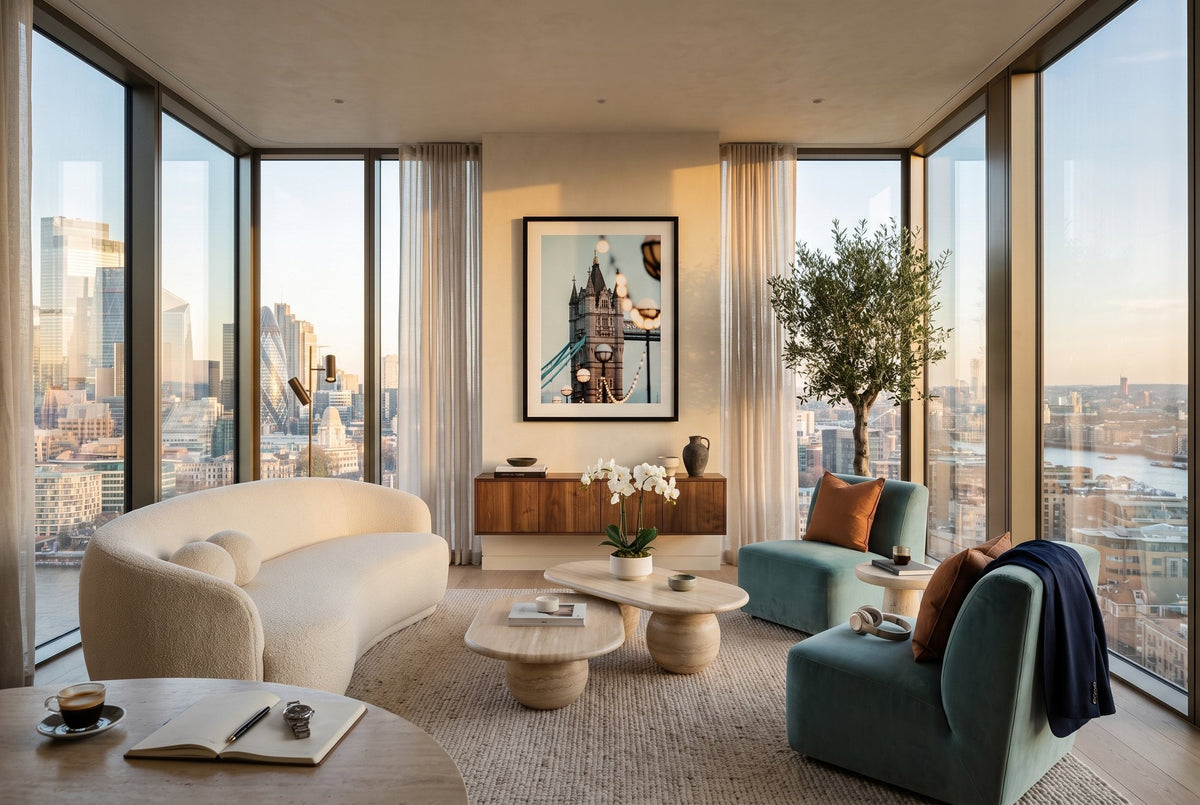
In London Tower Bridge III, the bridge is partially obscured by a sequence of street lamps.
I like that because the photograph doesn't present Tower Bridge perfectly.
You have to look through something to reach it.

View London Tower Bridge III →
The lamps create depth while repeating through the frame, and the bridge becomes part of the architecture around it rather than a clean postcard view.
Sometimes photographing a landmark becomes more interesting when you stop trying to remove everything in front of it.
The city is part of the photograph too.
Seeing the whole bridge differently
Other photographs in the collection move further away.
In London Tower Bridge II and London Tower Bridge I, the bridge sits within a much broader relationship with the Thames and the surrounding city.


Distance changes the subject.
Up close, you notice stone, steel and architectural detail.
Move further away and the bridge starts functioning as part of the city.
It connects two sides of the river.
Buildings rise behind it.
Boats move underneath it.
The Thames gives everything space.
It is still Tower Bridge, but the photograph becomes more about London.
Then The Shard enters the frame
One of the things I like most about London's skyline is that historical and contemporary architecture rarely appear separately.
Tower Bridge and The Shard are a perfect example.
One is immediately associated with an older London.
The other belongs unmistakably to the modern skyline.
Yet from the right viewpoint, they sit together naturally.
In London Tower Bridge and The Shard Black & White, removing colour makes that relationship even stronger.

View London Tower Bridge and The Shard Black & White →
There is less separating the two visually.
You start noticing shape instead.
The pointed geometry of The Shard.
The towers and suspension structure of the bridge.
Two completely different architectural periods occupying one frame.
That feels very London to me.
Why London works in black and white
London is an easy city to photograph without colour.
Part of that comes from the architecture.
Stone.
Brick.
Steel.
Glass.
Cloud.
The city already has so much texture and structure that colour isn't always necessary.
And historically, London almost seems to carry a black-and-white visual memory with it.
You remove the contemporary colour and suddenly certain scenes become difficult to place in a specific decade.
That is what I like about London Tower Bridge Lights Black & White.

View London Tower Bridge Lights Black & White →
The bridge remains immediately recognisable, but the photograph becomes more about light and shape than the particular colours of the city.
Black and white doesn't necessarily make London feel older.
It makes time less obvious.
Westminster through an arch
Sometimes the best way to photograph a landmark isn't to show it cleanly.
Westminster Through the Arch frames Elizabeth Tower and the Houses of Parliament through the dark shape of an arch.

View Westminster Through the Arch →
Most of the photograph is actually shadow.
That is what makes the view beyond it feel brighter.
I like using architecture to frame architecture.
It creates the sense of discovering something rather than simply standing directly in front of it.
And in London, those opportunities appear everywhere.
A doorway.
An arch.
A bridge.
A narrow street opening towards something familiar.
The city can reveal its landmarks gradually.
Familiar doesn't mean uninteresting
Big Ben is probably one of the most recognisable sights in Britain.
There is always a temptation when photographing something this familiar to search for an angle nobody has ever seen.
I don't think that is always necessary.
Sometimes the more useful question is simply:
What made me stop here?
Maybe it was the light.
Maybe it was the way an arch framed the tower.
Maybe it was a person entering the scene.
Maybe the familiar subject suddenly looked slightly unfamiliar.
There is enough pressure in travel photography to constantly discover something new.
But some places have been photographed repeatedly because they continue to work.
The challenge is to pay attention rather than simply reproduce the photograph you already know.
The Thames makes London easier to understand
London can feel dense from street level.
The Thames changes that.
Once you move above the city or further away from the riverbank, the river becomes a line through London.
Suddenly the relationship between different places becomes clearer.
Tower Bridge.
The Shard.
The City.
St Paul's.
Westminster.
Different pieces of London that feel separate while walking between them begin belonging to the same landscape.
London Skyline II
London Skyline II is one of those photographs where the river is just as important as any individual building.
Tower Bridge sits across the Thames while The Shard and the modern city rise around it.

The river creates negative space.
Without it, the photograph would be almost entirely architecture.
With it, the skyline has room to exist.
It also gives the image direction.
Your eye follows the water through the city.
London from above
Aerial photography changes London in the same way it changes many cities.
At street level, landmarks dominate.
From above, relationships dominate.
A famous building becomes one part of something much larger.
Roads, bridges, parks and the river start explaining how the city fits together.
In London Sunset II, Tower Bridge sits within a much wider view of the Thames.

You can see how the river curves through London and how much the city has developed around it.
The bridge is still instantly recognisable.
But it is no longer the entire photograph.
I often find that moving further away from a famous subject tells you more about it.
Sunset softens the city
London is often associated with grey skies.
And there is certainly no shortage of them.
But when the evening light works, the city can become surprisingly soft.
The stone takes on warmer tones.
The Thames starts reflecting the sky.
Glass buildings catch whatever colour remains on the horizon.
In London Sunset, the city feels very different from the harder architectural black-and-white photographs.

That variety is important to me within a collection.
London doesn't need to be presented entirely as dark, dramatic or monochrome.
The same architecture can feel completely different depending on what the sky is doing.
Then the city turns itself on
The transition after sunset is another moment I keep returning to in city photography.
There is a point when the remaining natural light and artificial city lights are almost balanced.
London works particularly well at that time because the Thames reflects so much of what is happening around it.
London City Lights over the Thames
In London City Lights over the Thames, the view stretches across the river as the city begins glowing beneath the last colour in the sky.

View London City Lights over the Thames →
From this height, individual buildings stop competing as strongly.
Street lights and windows begin connecting everything.
The Thames becomes darker.
The city becomes brighter.
For a few minutes, there is still enough light to see London as a landscape rather than only a collection of illuminated buildings.
That is often when I prefer to make the photograph.
Old London and new London
London's architecture can feel contradictory.
There are buildings designed hundreds of years apart standing within the same view.
Normally, you might expect that to feel visually disorganised.
In London, it has become part of the character.
Tower Bridge beside The Shard.
St Paul's surrounded by contemporary office buildings.
Westminster beneath construction cranes.
Historic façades reflected in glass.
The city doesn't seem frozen in its history.
It keeps building around it.
That is different from photographing somewhere preserved primarily as a historic centre.
London's past is still functioning inside the modern city.
People commute through it.
Work beside it.
Cross it.
Build around it.
That makes the architecture feel alive rather than simply preserved.
The photograph changes depending on distance
Something I notice repeatedly when photographing London is how much distance changes the story.
Photograph Tower Bridge closely and it becomes architecture.
Move further away and it becomes part of the skyline.
Move above it and it becomes part of the Thames.
Move far enough away and eventually it becomes one small landmark inside an enormous city.
None of those perspectives is more correct.
They simply answer different questions.
What does the bridge look like?
Where does it sit?
How does it relate to the river?
How does it belong to London?
Sometimes changing perspective is simply another way of understanding a place.
Photographing a city everyone already knows
London comes with the same challenge as New York, Paris, Venice or Tokyo.
Most people have seen it before they arrive.
Tower Bridge.
Big Ben.
The Thames.
Red buses.
Black cabs.
The photographs already exist in your head.
That makes it easy to search for confirmation.
You arrive at the landmark, find the expected view and photograph it.
There is nothing wrong with that.
But I find the more interesting part happens afterwards.
You walk slightly further.
Wait for the light to change.
Move behind something.
Look through an arch.
Go higher.
Let another building enter the frame.
The landmark gives you somewhere to begin.
It doesn't need to tell you where to finish.
Which London photograph works best in your space?
The London collection moves between warm skyline photography and much more architectural black-and-white work, so I would begin with the atmosphere you want in the room.
If you want something immediately recognisable, London Tower Bridge III is a strong place to start. The portrait composition and layered street lamps make it feel more intimate than a traditional wide skyline.
For a broader view of the city, London Skyline II shows Tower Bridge, the Thames and the surrounding architecture together.
London City Lights over the Thames brings warmer evening colour and works particularly well when you want a large cityscape with more depth and atmosphere.
For a contemporary or more minimal interior, the black-and-white Tower Bridge photographs place greater emphasis on architecture, line and contrast.
And Westminster Through the Arch is a different type of London photograph altogether. The landmark is recognisable, but the framing makes the image feel more graphic and less like a conventional city view.
There isn't one photograph that represents London completely.
The city has existed for too long and changed too many times for that.
From London to your wall
The London photography collection includes original photographs of Tower Bridge, Westminster, the River Thames and the wider London skyline.
The collection moves between aerial cityscapes, architectural details, sunset photography and black-and-white work.
Every photograph is available as a made-to-order framed artwork, printed using archival materials and hand-framed in Australia.
Black, white and natural oak framing allow the same London photograph to take on a very different character depending on the room.
Looking back through these photographs, what interests me most isn't simply how recognisable London is.
It is how many versions of the city can occupy the same photograph.
Something historic.
Something modern.
Something permanent.
Something still being built.
London is constantly changing.
But somehow it is always looking back.