


Hong Kong can feel almost impossible to take in at once.
There is always something behind something else.
Apartment towers rise behind older buildings. Mountains appear behind the skyline. Roads disappear beneath flyovers. Ferries cross the harbour while traffic moves in completely different directions underneath you.
Then, somewhere inside all of it, a red taxi passes through the frame.
The city doesn't really spread out.
It stacks.
That is probably what interests me most about photographing Hong Kong.
You can photograph it from far enough away that millions of windows become a pattern.
Or you can move into the streets and reduce the entire city to one car, one building or one moment.
Both photographs can feel equally like Hong Kong.
A city that grows upwards
Hong Kong has one of those skylines where architecture and geography are difficult to separate.
The buildings don't sit against an empty horizon.
Behind them are mountains.
In front of them is Victoria Harbour.
And between those two boundaries, an extraordinary amount of city has been built into a relatively small amount of space.
At street level, that density can feel overwhelming.
Look upwards and buildings seem to continue indefinitely.
Move higher, however, and the city begins to make more sense.
That is when you start seeing Hong Kong as layers rather than individual buildings.
Looking down from Kowloon Peak
Kowloon Peak gives you one of those perspectives where the scale of Hong Kong becomes immediately obvious.
From above, individual streets almost disappear.
Apartment towers become blocks of light.
Roads curve between them.
And beyond all of that, Victoria Harbour separates Kowloon from Hong Kong Island.
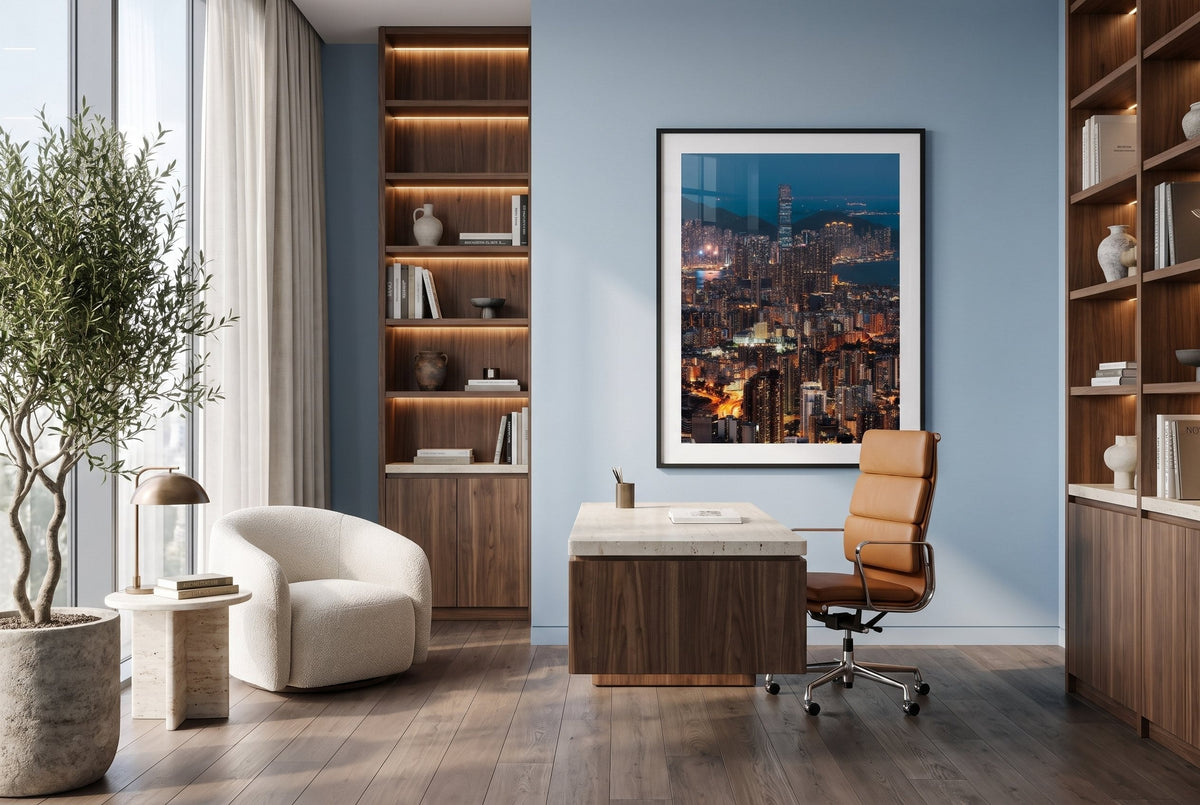
In Hong Kong Blue Hour From Kowloon Peak, what interests me isn't one particular landmark.
It is the amount of city inside the frame.

View Hong Kong Blue Hour From Kowloon Peak →
There is almost no empty space.
Your eye can begin with one building and keep moving through thousands more.
The higher you look, the more Hong Kong seems to continue.
Why blue hour works so well here
Some cities become quieter visually after sunset.
Hong Kong doesn't.
It becomes brighter.
Blue hour is one of my favourite times to photograph dense cities because natural light hasn't disappeared completely, but artificial light has already started taking over.
For a short period, both exist together.
From Kowloon Peak, the sky becomes deep blue while thousands of windows, roads and buildings begin illuminating themselves below.
That transition creates a very different photograph from the same viewpoint during daylight.
During the day, architecture dominates.
At blue hour, light starts defining the city instead.
Hong Kong Blue Hour From Kowloon Peak II explores that same density from another composition.

View Hong Kong Blue Hour From Kowloon Peak II →
I like photographing the same place more than once for exactly this reason.
The location can stay unchanged.
The photograph doesn't have to.
Victoria Harbour creates the space
For all the density of Hong Kong, the harbour gives the city something it desperately needs visually.
Space.
Looking towards Hong Kong Central from across Victoria Harbour, the skyline suddenly has room around it.
Buildings that felt almost impossible to separate at street level become individual shapes.
The water creates distance.
And distance creates perspective.
Hong Kong Central at sunset
In Hong Kong Central Sunset, the skyline is still the obvious subject, but the harbour is just as important.
Without it, the photograph would be almost entirely architecture.
With it, there is somewhere for the eye to rest.

View Hong Kong Central Sunset →
That balance between density and open water is one of the things that makes Hong Kong so visually distinctive.
The city can feel incredibly compressed.
Then you reach the harbour and suddenly everything opens.
Waiting for the city lights
Hong Kong Central Sunset II captures another stage of that transition.
The last warm colour remains in the sky while the buildings along the harbour have already started glowing.

View Hong Kong Central Sunset II →
This is often the point when I enjoy photographing skylines most.
If you wait until complete darkness, the city becomes almost entirely artificial light.
Photograph too early and those lights don't register strongly enough.
The few minutes in between allow both to exist.
Clouds still have shape.
The sky still has colour.
The harbour still reflects some of that natural light.
But Hong Kong has begun switching itself on.
Sometimes a photograph is less about finding the right place than being there for the right five minutes.
Then there is the red taxi
Hong Kong doesn't always need a skyline.
Sometimes one red taxi is enough.
That is what I like about Hong Kong Red Taxi.
The photograph is almost the opposite of the Kowloon Peak images.
There is no attempt to explain the entire city.
The taxi moves through the frame while everything around it becomes blurred by motion.

It is a small moment.
But the red taxi is so closely connected with the visual experience of Hong Kong that the location doesn't need much explanation.
I also like what the motion does to the photograph.
Cities are rarely experienced standing perfectly still.
Cars pass.
People cross streets.
Traffic lights change.
Buildings remain in place while everything around them moves.
A slower shutter can sometimes describe that feeling better than freezing everything sharply.
The taxi is identifiable.
The city around it becomes movement.
The photographs between the landmarks
This is something I keep coming back to in travel photography.
Landmarks are useful.
They immediately tell you where you are.
But sometimes the smaller everyday details become more memorable.
A taxi.
A tram.
A basketball court.
An apartment window.
A street crossing.
These aren't necessarily the things somebody travels across the world specifically to see.
But once you've spent time somewhere, they can become part of how you remember it.
That is particularly true in Hong Kong.
The city has famous skyline views, but its identity is also built from hundreds of much smaller visual details.
Choi Hung and colour inside the density
Hong Kong Rainbow Building takes the collection in another direction again.
The photograph looks towards the colourful basketball court at Choi Hung Estate, surrounded by the repeated windows and balconies of the residential buildings behind it.

View Hong Kong Rainbow Building →
The first thing you notice is probably the colour.
Blue.
Orange.
Green.
Pastel sections across the building.
But underneath the colour, the photograph is really about repetition.
Window after window.
Apartment after apartment.
A huge residential building filling almost the entire background.
Then the basketball court creates a simple geometric foreground.
It is another example of something I find fascinating about Hong Kong.
A scene can feel extremely dense and very ordered at the same time.
One basketball hoop changes the scale
Small human elements are often important in architectural photography.
Without the basketball hoop and court, the building could become almost abstract.
You would see windows, colours and repetition, but there would be less sense of how large everything actually is.
The court gives the photograph scale.
Suddenly those hundreds of windows become homes.
The architecture stops being a pattern and becomes somewhere people live.
That distinction matters to me.
Hong Kong isn't visually interesting because it has a lot of buildings.
It is interesting because so much life has been compressed into them.
Hong Kong without colour
With so much neon, red signage, blue water and illuminated architecture, Hong Kong seems like an obvious city to photograph in colour.
Which is exactly why I also like seeing it without any.
The current collection includes several black-and-white Hong Kong skyline photographs.
Removing colour does something interesting to a city this dense.
The signs become less important.
Different building materials become less distracting.
What remains is structure.
Windows.
Lines.
Light.
Shadow.
And the relationship between hundreds of buildings sitting beside one another.
Hong Kong Central in black and white
In Hong Kong Central Skyline Black and White, the skyline becomes much more architectural.
Colour no longer separates one building from another.
Shape does.

View Hong Kong Central Skyline Black and White →
It also changes the mood.
A colourful Hong Kong skyline tends to feel energetic and contemporary.
In black and white, the same density can feel quieter and almost timeless.
That is one of the reasons I don't think colour versus black and white is simply a stylistic decision.
It changes what the photograph is about.
When the skyline becomes a pattern
The wider black-and-white views take that idea further.
In Hong Kong Skyline Black and White and Hong Kong Island Skyline Black and White, individual buildings become less important than the city as a whole.

View Hong Kong Skyline Black and White →

View Hong Kong Island Skyline Black and White →
From far enough away, Hong Kong starts becoming almost abstract.
Thousands of windows create texture.
Skyscrapers create rhythm.
Mountains form one layer.
Buildings another.
The harbour another.
This is where the density stops feeling chaotic and begins to feel organised.
You just have to move far enough away to see it.
Hong Kong from far away and close up
That is probably the biggest contrast within this collection.
Some photographs try to contain almost the entire city.
Others contain almost nothing.
A skyline from Kowloon Peak.
Then a red taxi.
Thousands of apartments.
Then one basketball hoop.
Victoria Harbour.
Then one moving car.
I don't think one approach is more honest than the other.
Cities are experienced at different distances.
There are moments when Hong Kong feels enormous.
And there are moments when your entire experience of it is one street corner.
Both belong in the collection.
Why Hong Kong feels cinematic
There is a reason Hong Kong has such a strong presence in cinema and photography.
The city gives you layers naturally.
Foreground.
Background.
Reflections.
Traffic.
Light.
Signs.
Architecture.
Mountains.
Water.
You often don't need to manufacture depth in the composition because the city has already done it for you.
At night, that becomes even stronger.
Light appears from different heights and distances.
A brightly illuminated sign might be metres away while thousands of apartment windows glow across the harbour.
Rain or humidity can soften the distant buildings.
Traffic creates movement underneath everything.
The result can feel cinematic before you have done very much at all.
The difficult part is deciding which piece of that visual information actually matters.
Density can also create quiet photographs
For all of Hong Kong's visual intensity, I don't think every photograph needs to feel loud.
Move far enough away and the city becomes calm.
Remove colour and the architecture becomes restrained.
Wait for the right light and even hundreds of buildings can sit quietly beneath a darkening sky.
That contrast is important.
It would be easy to photograph Hong Kong only as neon, traffic and density.
Those things are real.
But they aren't the entire city.
Sometimes the thing that interests me most is seeing one of the world's densest urban environments from enough distance that it almost becomes peaceful.
Photographing a city that keeps changing
Architecture gives city photography an interesting relationship with time.
A mountain can remain almost unchanged across generations.
Cities don't.
Buildings are demolished.
Skylines become taller.
Signs disappear.
Businesses close.
Transport changes.
Neighbourhoods evolve.
Hong Kong makes that particularly visible because so much architecture occupies the same frame.
A cityscape is never only a photograph of buildings.
Eventually it becomes a record of what the city looked like at one particular moment.
That wasn't necessarily what I was thinking about when I pressed the shutter.
But over time, it becomes part of the photograph.
Which Hong Kong photograph works best in your space?
The Hong Kong collection moves between very colourful urban photography and much quieter monochrome work, so I would start with the atmosphere you want rather than simply the landmark.
If you want Hong Kong at its most visually intense, Hong Kong Blue Hour From Kowloon Peak is the natural starting point. The vertical composition and thousands of city lights make it particularly suited to a narrower statement wall.
For something with more open space, Hong Kong Central Sunset and Hong Kong Central Sunset II balance the skyline against Victoria Harbour and the changing evening sky.
Hong Kong Red Taxi is completely different. It feels more contemporary, graphic and energetic, and works well if you want urban photography without a traditional skyline.
For stronger colour, Hong Kong Rainbow Building combines architecture with a much brighter palette and a highly geometric composition.
And if your interior is more restrained, the black-and-white skyline series removes much of the visual intensity while keeping the architecture and scale that make Hong Kong recognisable.
There isn't really one Hong Kong.
There is the city from above.
The city from across the harbour.
And the city moving past you at street level.
From Hong Kong to your wall
The Hong Kong photography collection includes original photographs of Victoria Harbour, Central, Kowloon Peak, Choi Hung Estate and everyday urban details such as the city's red taxis.
The collection moves between colourful sunset and blue-hour cityscapes, architectural photography, motion and black-and-white skyline work.
Every photograph is available as a made-to-order framed artwork, printed using archival materials and hand-framed in Australia.
Black, white and natural oak frames allow the same photograph to take on a very different character once it enters a room.
When I think about Hong Kong, I don't really remember one view.
I remember layers.
A mountain behind a building.
Another building behind that.
A harbour in front of everything.
A road somewhere below.
And for a fraction of a second, a red taxi moving through it all.
Maybe that is why Hong Kong is so difficult to capture in one photograph.
There is always another layer underneath it.