


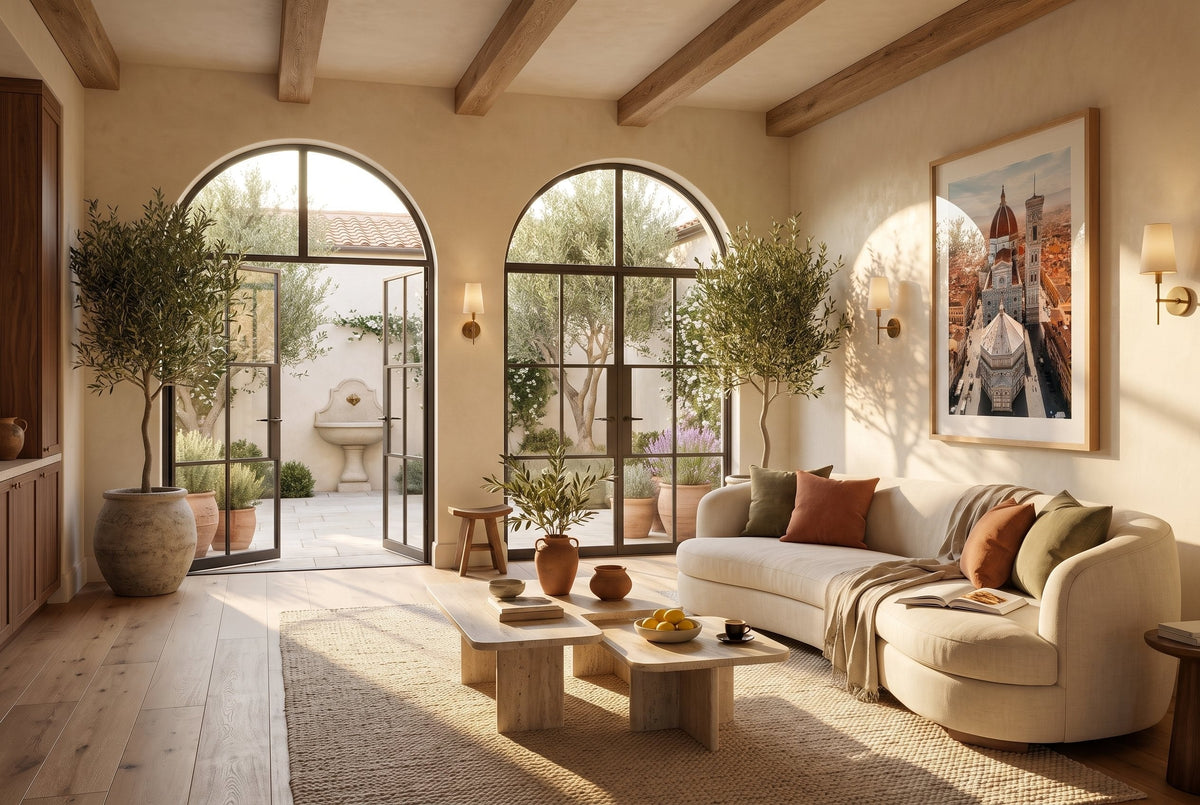
Italy is difficult to describe through a single photograph.
Every time I travel through another part of the country, the visual language seems to change.
In the north, the Dolomites rise out of lakes and alpine valleys.
A few hours away, Venice seems to exist almost entirely between architecture and water.
Florence is warm stone, tiled rooftops and one enormous cathedral dominating the city.
Further south, villages are built vertically into cliffs above the Mediterranean.
Then there is Rome, where thousands of years of architecture sit inside a modern city as though that is completely normal.
They are all unmistakably Italian.
But they barely look like the same country.
That contrast is what has made Italy one of the places I keep wanting to photograph.
Florence from above
Florence is a city that becomes easier to understand when you get above it.
At street level, the historic centre can feel dense.
Narrow streets run between stone buildings and suddenly open into piazzas. The Cathedral of Santa Maria del Fiore appears above rooftops, disappears again, then reappears a few streets later.
From above, everything changes.
The Duomo becomes the centre of the city.
Its enormous terracotta dome rises above an almost continuous field of warm-coloured rooftops.
In Florence's Duomo and Baptistery from Above, that relationship is the photograph.
The cathedral is extraordinary by itself, but what interests me just as much is the city surrounding it.

View Florence's Duomo and Baptistery from Above →
The buildings seem tightly packed together until the cathedral suddenly creates space around itself.
From this perspective, you begin to understand not only what the Duomo looks like, but what it means to the shape of Florence.
Florence when the light changes
I have photographed Florence at different times of day because the colour of the city changes so dramatically with the light.
At sunrise, everything feels softer.
The rooftops gradually catch the first warmth of the day while the streets below are still comparatively quiet.
At sunset, those same terracotta roofs become much richer.
Florence Cathedral at Sunset is one of those photographs where the architecture and the light are equally important.

View Florence Cathedral at Sunset →
That is something I find repeatedly in Italy.
The buildings already have so much colour and texture that light doesn't simply illuminate them.
It changes their character.
The same city photographed an hour later can feel completely different.
Venice doesn't behave like another city
Then you arrive in Venice and many of the normal rules disappear.
There are no ordinary streets through much of the city.
Water becomes the road.
Boats become taxis.
Buildings don't simply face canals. They seem to grow directly out of them.
Photographically, this means almost every composition has two versions.
There is the architecture.
And then there is whatever the water does with it.
Reflections stretch buildings vertically.
A gondola breaks an otherwise perfect surface.
Light from a window appears again underneath it.
In Venice Evening, the city begins illuminating itself while the last natural light remains in the sky.

It is one of my favourite times to photograph Venice because neither daylight nor night has completely taken over.
For a short period, the two exist together.
The smaller details of Venice
It is easy to arrive in Venice thinking only about the Rialto Bridge, St Mark's Square or the Bridge of Sighs.
They deserve to be photographed.
But much of what makes Venice interesting happens between those landmarks.
A gondola appearing beneath a small bridge.
A weathered wall beside a canal.
Old timber doors opening directly onto the water.
An arcade repeating into the distance.
I think this is true of Italy more generally.
The famous architecture gets you there.
The smaller details often become the photographs you remember.
Explore the Venice photography collection →
Cinque Terre and the lack of flat land
Cinque Terre changes the visual language again.
The villages are smaller.
The landscape becomes more dominant.
And almost everything appears to have been built wherever there was enough space to put it.
From above, this becomes particularly obvious.
Riomaggiore, Vernazza and Manarola sit between steep hillsides and the Ligurian Sea, with houses stacked closely together and tiny harbours occupying the narrow gaps where the land meets the water.
Riomaggiore Sunset, Cinque Terre II is a good example.
The colourful buildings fill one side of the composition while the sea gives the other side almost complete simplicity.

View Riomaggiore Sunset, Cinque Terre II →
That contrast is what I like about photographing Cinque Terre.
The villages are visually intense.
The sea is not.
Put the two together and each makes the other stronger.
Seeing the villages from above
Aerial photography also makes the geography of Cinque Terre much clearer.
At street level, you notice houses, stairways and narrow passages.
From above, you notice how improbably everything fits into the landscape.
In Vernazza Sunset, Cinque Terre, the harbour becomes a shape rather than simply a place.
Boats, stone walls and colourful buildings form a small pocket inside a much larger coastline.

View Vernazza Sunset, Cinque Terre →
It reminds me that architecture isn't always designed independently of the landscape.
Sometimes the landscape decides everything first.
The buildings simply have to work around it.
Explore the Cinque Terre photography collection →
The Amalfi Coast feels larger
The Amalfi Coast shares some obvious similarities with Cinque Terre.
Colourful towns.
Steep mountains.
Mediterranean water.
Buildings constructed against landscapes that seem to leave very little room for them.
But photographically, they feel different to me.
Cinque Terre feels compressed.
The Amalfi Coast feels expansive.
Roads curve across enormous mountainsides. Towns stretch vertically along cliffs. Villas and terraces appear high above the sea.
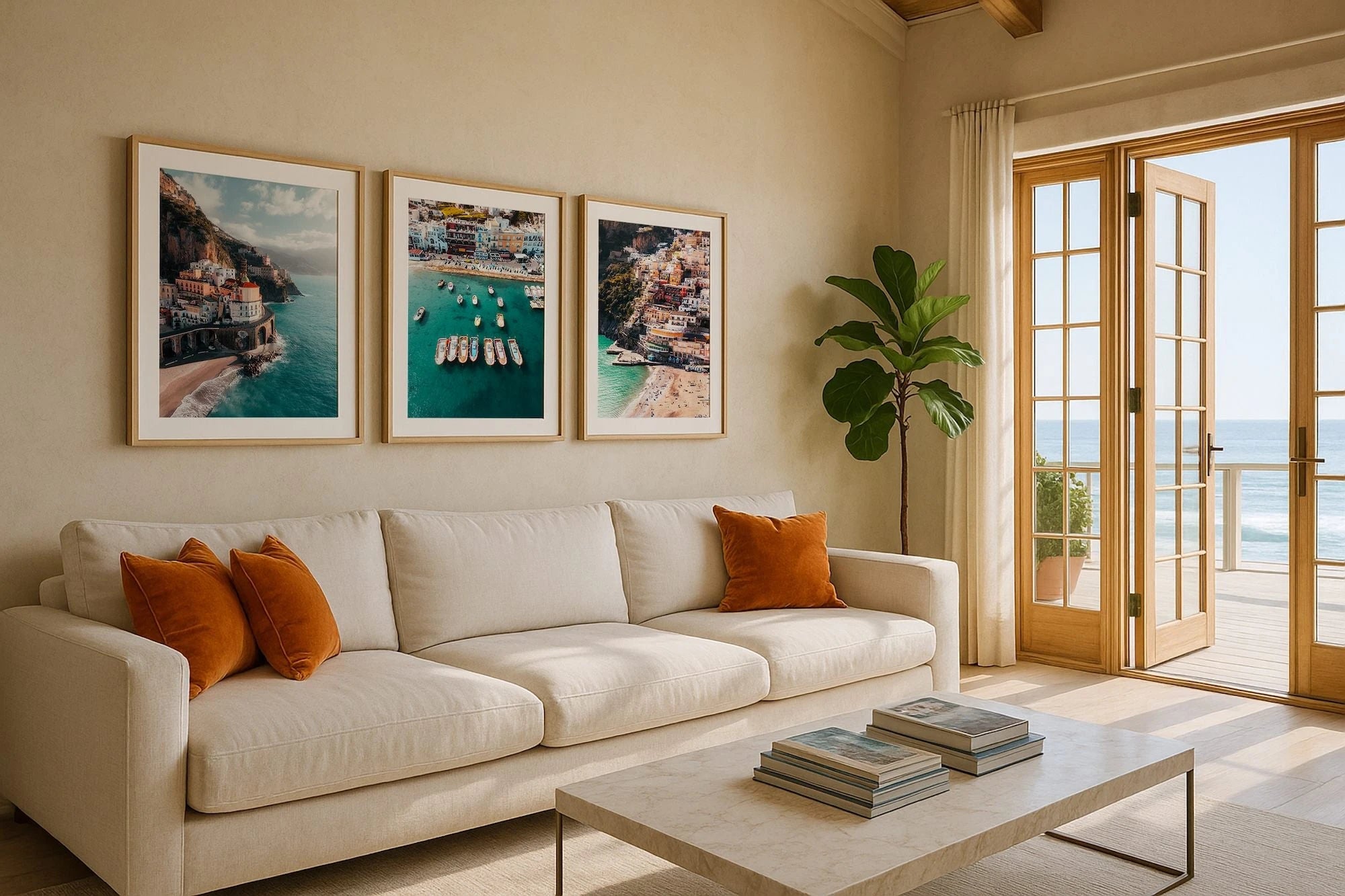
Positano might be the clearest example.
From a distance, the town almost looks as though someone has poured hundreds of buildings down the side of a mountain.
Positano in daylight
In Positano Sunny Afternoon, Amalfi Coast, colour is a major part of the photograph.
The buildings compete with the water, mountains and sky.
It is visually busy.
And I think that suits Positano.

View Positano Sunny Afternoon, Amalfi Coast →
There are places where I try to simplify the frame.
Positano isn't always one of them.
Sometimes the density is the subject.
The same coast after sunset
Wait until blue hour and Positano becomes almost another place.
The colours of the buildings become less obvious.
Streetlights and windows begin appearing across the hillside.
The sea becomes darker and the whole town seems to glow from inside.
That is what I wanted in Positano at Blue Hour.
The location hasn't changed.
The visual hierarchy has.
During the day you notice the buildings.
At blue hour, you notice the light between them.

That is one reason I enjoy returning to the same location at different times.
Finding somewhere new is exciting.
Finding a completely different photograph in somewhere you already know can be even better.
Explore the Amalfi Coast photography collection →
Atrani before the coast wakes up
Not far away, Atrani feels more contained.
It doesn't have the same immediate visual scale as Positano, and I think that is part of its appeal.
In Atrani Sunrise, Amalfi Coast, the early light keeps the scene relatively quiet.
The village sits against the cliffs while the Mediterranean occupies a large part of the frame.

View Atrani Sunrise, Amalfi Coast →
It feels less like a photograph trying to capture an entire destination and more like one moment within it.
Italy is full of places where you can point a camera in almost any direction and find something beautiful.
The harder part is deciding how much to include.
Capri and the colour of the water
Then there is Capri.
Arriving around Marina Grande, one of the first things you notice is the water.
Colour can be difficult to reproduce honestly in travel photography because there is always a temptation to push it further than it really was.
In places like Capri, you don't need to.
In Capri Marina Grande, the boats provide small points of colour while the Mediterranean does most of the work.

From above, the marina becomes graphic.
Boats line up.
Water fills the negative space between them.
Buildings rise behind the harbour.
It is recognisably Italy, but visually it has very little in common with Florence or Venice.
That is exactly why I like putting these photographs within the same collection.
Rome and layers of history
Rome is different again.
There are cities where historical architecture has been carefully separated from modern life.
Rome doesn't always feel that way.
Ancient ruins, churches, fountains, apartments, cars and cafés can all exist within the same few streets.
You can spend an entire day walking through different centuries without really thinking about it.
The Trevi Fountain is one of the city's most photographed places.
During most of the day, it is also one of the busiest.
That makes early morning particularly valuable.
Trevi Fountain at sunrise
Trevi Fountain Sunrise I was photographed when the square felt very different from the version most visitors experience later in the day.
Without a dense crowd occupying the foreground, the architecture becomes much easier to see.

View Trevi Fountain Sunrise I →
The sculptures, stone and water finally have room within the frame.
It is a reminder that sometimes the best way to photograph a famous place isn't finding an unusual angle.
It is simply being there when everything around it is different.
Matera after dark
Matera has perhaps the most unusual visual identity of any Italian city I have photographed.
Buildings seem to emerge directly from the stone.
From a distance, it can be difficult to tell where the natural landscape stops and the architecture begins.
At night, that relationship becomes even stronger.
In Matera Lights, hundreds of small points of warm light trace the shape of the city.

Instead of one major landmark dominating the frame, the entire landscape becomes the subject.
Matera feels ancient in a completely different way from Rome.
Rome presents history through monumental architecture.
Matera feels as though people have simply been living inside the landscape for an extremely long time.
Then Italy becomes mountains
Travel far enough north and almost every visual idea associated with Mediterranean Italy disappears.
The Dolomites could belong to another country entirely.
Colourful villages beside the sea are replaced by enormous peaks.
Canals become alpine lakes.
Dense architecture gives way to open landscape.
This is perhaps the clearest example of why I find it difficult to describe an “Italian photography style”.
Italy doesn't give you one.
Lago di Braies
At Lago di Braies, still water can turn the mountains into almost perfect reflections.
Wooden boats introduce the human scale.
Without them, the peaks can be difficult to comprehend.
In photographs such as Lago di Braies Boats and Reflections II, those small boats become surprisingly important.
They tell you how enormous everything else is.

View Lago di Braies Boats and Reflections II →
The Dolomites without colour
I also find the Dolomites particularly suited to black-and-white photography.
Remove the blue sky and green landscape and the mountains become almost entirely about shape, texture and light.
In Dolomites Peaks in Black and White II, there isn't much to distract from the scale of the peaks themselves.

View Dolomites Peaks in Black and White II →
This is almost the opposite of photographing somewhere like Positano.
There, colour is part of the identity.
Here, removing colour can make the landscape feel stronger.
That difference is what makes photographing across Italy so interesting.
The country doesn't ask you to solve the same visual problem twice.
Explore the Dolomites photography collection →
Why I keep photographing Italy
Italy is one of the easiest places to photograph badly.
There is simply too much that already looks beautiful.
It is easy to arrive at a famous viewpoint, take the obvious photograph and move on.
I have taken plenty of those photographs.
Sometimes the obvious view is famous because it really is the best view.
But the photographs I keep returning to usually happen when something else enters the equation.
A particular hour of light.
A boat.
A reflection.
An empty piazza.
A different elevation.
A person giving the landscape scale.
A famous building partially hidden by the city around it.
Those details turn a record of a place into something more personal.
Italy provides the subject very easily.
Finding the photograph still takes time.
Italy isn't one collection
When all of these photographs sit together, they almost shouldn't work.
The Dolomites have very little visually in common with Capri.
Matera doesn't look like Venice.
Florence doesn't look like Positano.
Cinque Terre doesn't feel like Rome.
Yet there are connections.
The way cities have adapted to their landscapes.
The amount of history visible in everyday life.
The relationship between architecture and natural surroundings.
The importance of light.
And perhaps most of all, the feeling that beauty hasn't been separated from ordinary life.
People live beside buildings that others travel across the world to see.
They buy groceries beneath medieval towers.
They commute past ruins.
They park scooters beside churches.
They drink coffee beside canals.
That combination of the extraordinary and the everyday might be the thing I find most interesting about photographing Italy.
Which Italian photograph works best in your space?
With such a varied collection, I wouldn't begin by asking which Italian landmark you like most.
I'd start with the feeling you want the artwork to bring into the room.
For colour and warmth, the Amalfi Coast, Capri and Cinque Terre photographs are a natural fit. Mediterranean blues, colourful architecture and warmer light make these pieces particularly strong in light or neutral interiors.
For something quieter and more architectural, Florence and Venice offer strong geometry, historic detail and several black-and-white options.
The Dolomites move in a completely different direction. Those photographs work particularly well when you want the artwork to feel open, natural and expansive.
Rome and Matera bring more history and texture, with architecture becoming the dominant subject.
And if you're choosing a larger statement piece, I often prefer compositions with enough detail to reward being seen at scale: Florence from above, the layered towns of the Amalfi Coast or one of the wider Dolomites landscapes.
There isn't really one Italian aesthetic.
That's the point.
The right photograph depends on which Italy you want to live with.
From Italy to your wall
The Italy photography collection brings together original photographs from the Amalfi Coast, Cinque Terre, Venice, Florence, Rome, Matera, Capri and the Dolomites.
The collection moves between coastal landscapes, aerial photography, historic architecture, alpine scenery, city photography and black-and-white work.
Every photograph was captured by Peter Yan and is available as a made-to-order framed artwork.
Each piece is printed using archival materials and hand-framed in Australia, with black, white and natural oak frame options.
Looking through the collection now, what strikes me isn't how consistent Italy looks.
It is how inconsistent it is.
One photograph can be a quiet alpine lake.
The next can be hundreds of buildings falling towards the Mediterranean.
Then a canal in Venice.
A cathedral in Florence.
An ancient city glowing after dark.
All from the same country.
Maybe that is why Italy continues to be one of the places I find hardest to stop photographing.
Every time you think you understand how it looks, you travel a little further.
And it changes again.
Explore the complete Italy photography collection →
If you are choosing which Italy to hang at home — Amalfi colour, Venice streets, Florence from above, or the Dolomites — start with our calm guide to Italy and Amalfi Coast photography prints for the home.