


Japan is one of those places I never seem to finish photographing.
Every time I think I understand what draws me to it, something completely different catches my attention.
It can be Mount Fuji appearing almost perfectly still behind a convenience store.
A Shinkansen moving through the landscape beneath it.
A quiet row of torii gates in Kyoto.
Or Shinjuku at night, when rain turns every sign, taxi and street light into a reflection.
Those scenes have almost nothing in common visually.
Yet somehow they all feel unmistakably Japan.
That contrast is probably what keeps bringing me back to the camera.
Mount Fuji and the everyday
Mount Fuji is one of the most photographed mountains in the world.
That makes it an obvious subject, but not necessarily an easy one.
The photographs I find most interesting aren't always the ones where Fuji stands alone in a perfect landscape.
Often it is the ordinary things around it that make the scene feel more Japanese.
A street.
Powerlines.
A train.
A convenience store.
The contrast between something so permanent and something so everyday is what first interested me in photographing Fuji this way.
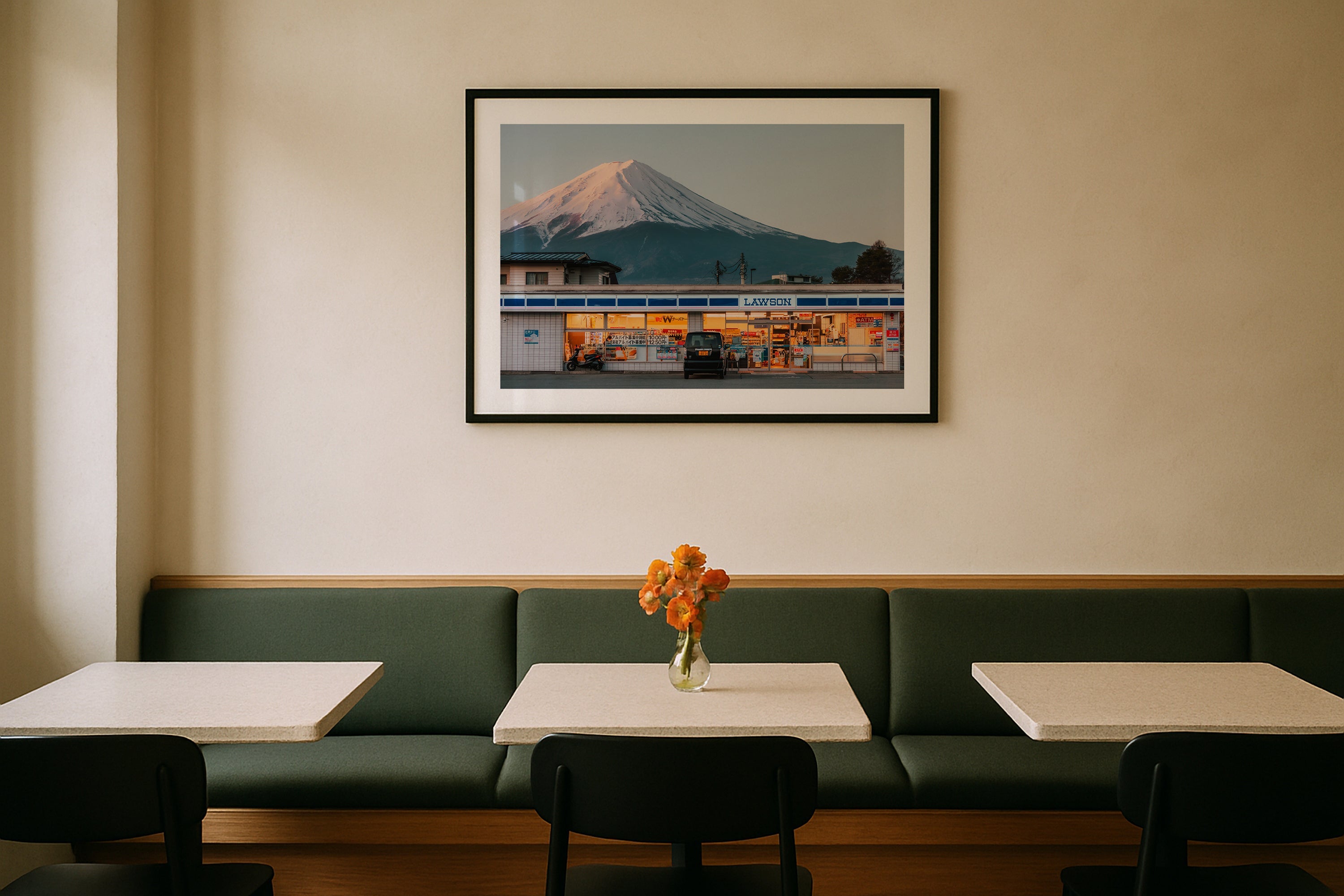
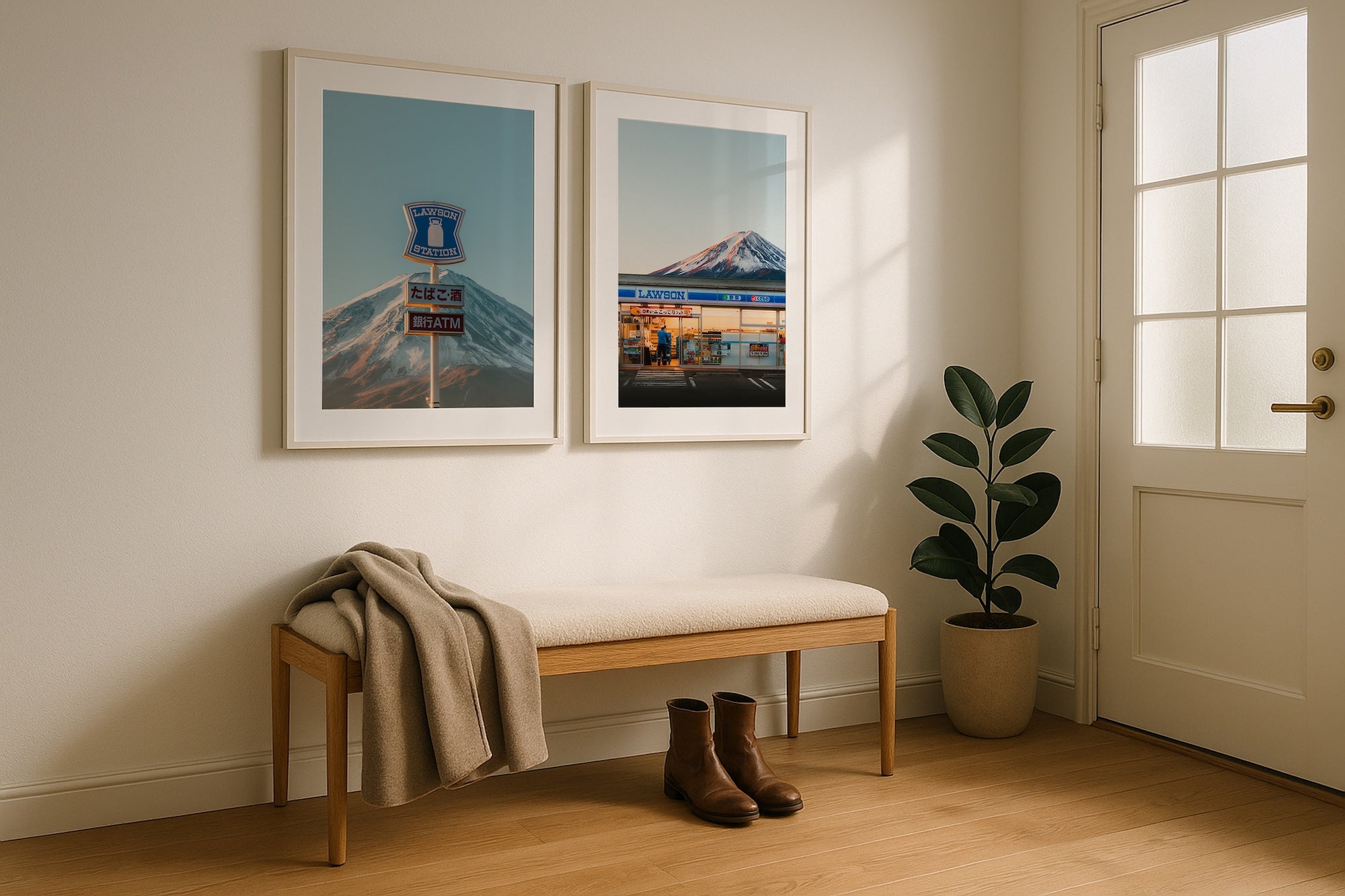
Mt Fuji Lawson
A Lawson convenience store shouldn't really compete visually with Mount Fuji.
But somehow it does.
The blue signage, fluorescent interior and car park belong to ordinary daily life. Behind all of it sits one of the most recognisable natural landscapes in the world.
That contradiction is what makes Mt Fuji Lawson Sunrise interesting to me.
The photograph isn't really only about Fuji.
It is about the way Japan can place something completely ordinary beside something extraordinary and somehow make the two feel like they have always belonged together.

I have photographed this relationship in different light and from different positions around Kawaguchiko.
At blue hour, the convenience store begins glowing while the mountain becomes quieter. That is what I wanted in Mt Fuji Lawson Blue Hour.
At sunrise, Fuji becomes clearer while everything below it is still waking up.
The location barely changes.
The photograph does.
The Shinkansen beneath Fuji
There is another photograph that expresses Japan in a completely different way.
Mt Fuji Shinkansen places two Japanese icons within the same frame.
One has existed for thousands of years.
The other crosses the landscape at hundreds of kilometres an hour.
I like that contrast.
Japan can feel deeply attached to tradition while simultaneously being obsessed with what comes next.
In the photograph, the Shinkansen occupies only a small part of the frame.
Fuji still dominates.
But the train gives the image movement and scale. Without it, the mountain is simply beautiful. With it, there is suddenly a story about Japan.

Sometimes the smallest element in a photograph is the thing that explains the entire scene.
Tokyo after dark
Then there is Tokyo.
Almost everything changes.
The space disappears.
The quiet disappears.
Instead there are signs, people, taxis, trains, narrow streets and buildings stacked above buildings.
During the day, Tokyo can already feel visually overwhelming.
At night, it becomes something else entirely.
And when it rains, it gets even better.
One rainy night in Shinjuku
Rain changes the way I photograph cities.
Normally, light comes from above or from whatever is directly in front of the camera.
On a wet night in Shinjuku, it seems to come from everywhere.
Neon signs reflect in the road.
Headlights stretch across the pavement.
Umbrellas catch small pieces of colour.
Even ordinary streets become more cinematic.
That is what I enjoy about photographs such as Godzilla Head Shinjuku Rainy Night and One Rainy Night in Shinjuku.
They aren't quiet photographs.
There is almost too much happening.
But that intensity is part of Tokyo.
Rather than trying to simplify it, sometimes the better photograph is the one that accepts the chaos.

View Godzilla Head Shinjuku Rainy Night →

View One Rainy Night in Shinjuku →
Finding order inside Tokyo
At the same time, Tokyo can be incredibly graphic.
You don't always need a famous landmark.
Sometimes it is just repetition.
Windows.
Doors.
Signs.
People moving through architecture.
Colourful Doors of Tokyo is one of those photographs where the location becomes almost abstract.
Rows of illuminated doors form a pattern against the darker building, while a single person gives the scene scale.
You could look at it first as colour and geometry before even thinking about where it was photographed.
I like photographs that work that way.
The place gives the image meaning, but the composition can stand on its own.

View Colourful Doors of Tokyo →
Tokyo in spring
Cherry blossom season brings another version of the city.
Japan during sakura can be incredibly beautiful, but photographically it is easy to make every image about the flowers themselves.
I prefer when the blossom becomes part of everyday life.
In Tokyo Taxis Under The Cherry Blossoms, the taxis and street still make the photograph feel urban.
The sakura changes the mood rather than becoming the entire subject.
For a few weeks, something soft and temporary sits against one of the world's densest cities.
Then it disappears again.
Maybe that is part of why people respond so strongly to cherry blossoms.
You know the scene isn't going to last.

View Tokyo Taxis Under The Cherry Blossoms →
Kyoto moves at a different pace
Leaving Tokyo for Kyoto can feel like changing photographic languages.
There is still complexity, but it appears differently.
Wood.
Stone.
Gardens.
Temple roofs.
Lanterns.
And repetition that has existed for generations rather than being created by advertising signs and office buildings.
Fushimi Inari is perhaps the clearest example.
Thousands of vermilion torii gates create a subject that is instantly recognisable, but what interests me photographically is the repetition.
One gate isn't particularly complex.
Hundreds together become something completely different.
In Fushimi Inari Shrine Torii Gates, the path disappears through layer after layer of red.
Your eye knows where it should go without needing to be told.

View Fushimi Inari Shrine Torii Gates →
It is almost the opposite of Shinjuku.
One scene is filled with unrelated information.
The other is built from the repetition of essentially one thing.
Yet I find both equally interesting to photograph.
Japan through the seasons
Japan also changes dramatically depending on when you arrive.
A photograph of the same place in autumn can feel unrelated to one made during cherry blossom season.
That seasonal change is particularly visible around temples, castles and Mount Fuji.
At Himeji Castle, sakura softens an otherwise enormous architectural structure.
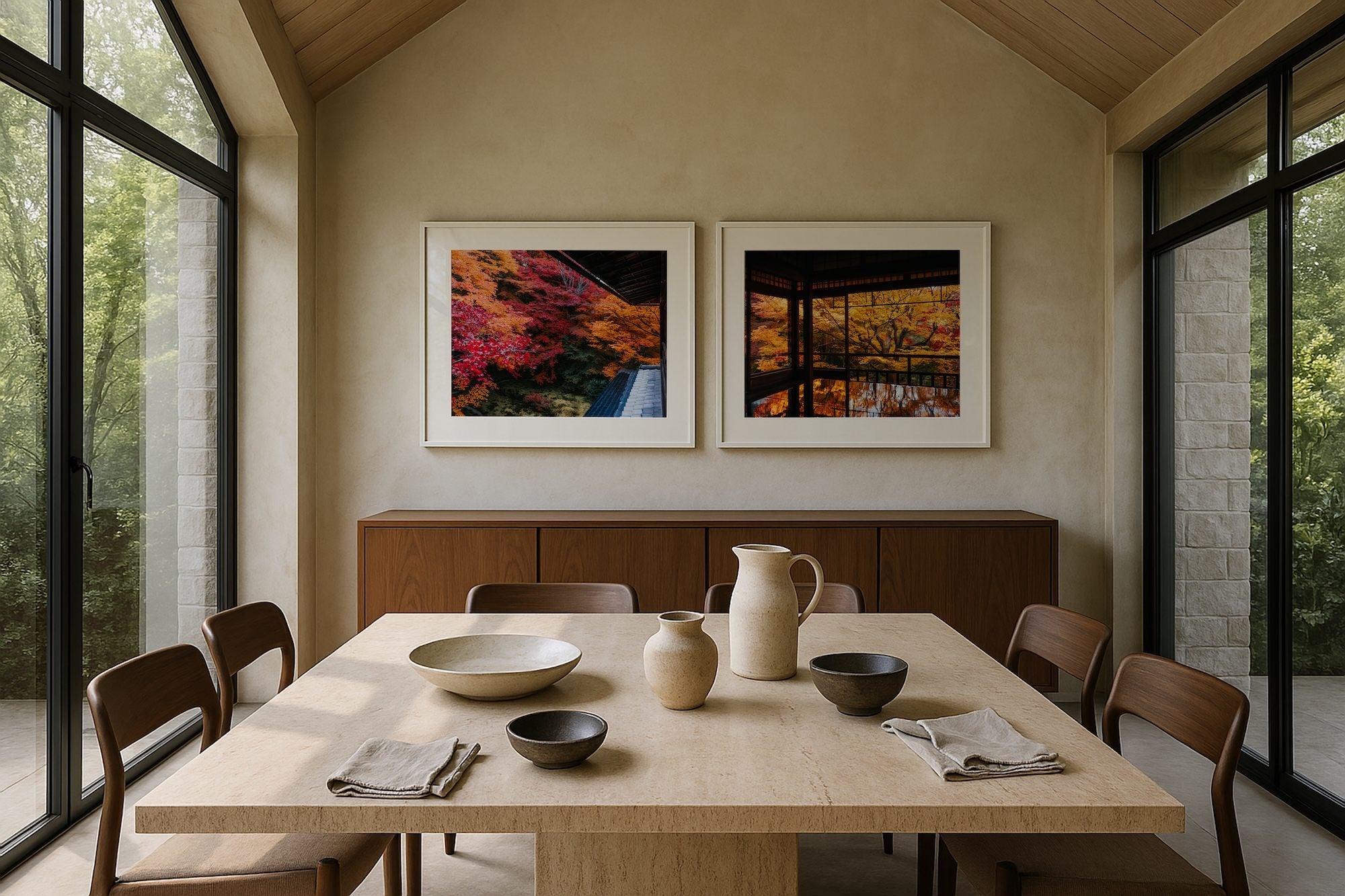
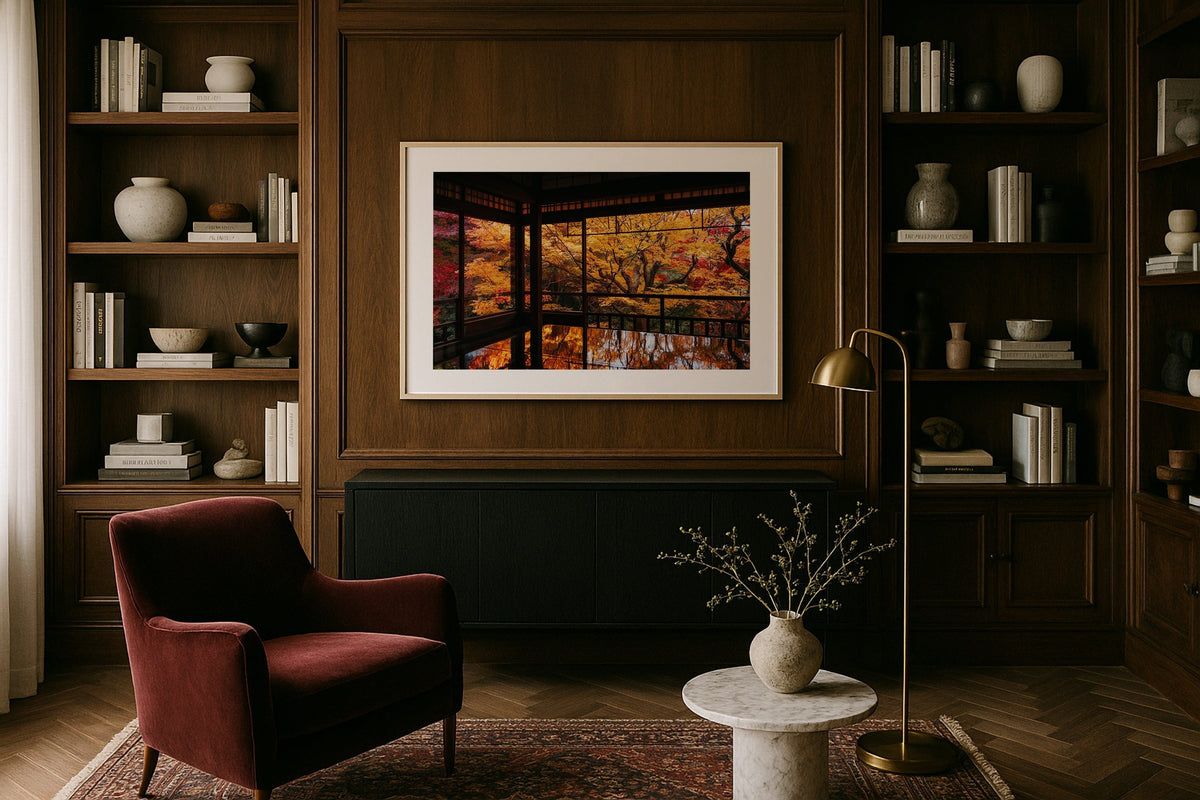
Around Fuji, autumn leaves can become the foreground while the mountain remains almost unchanged behind them.
That relationship between something permanent and something temporary appears again and again in Japan.
Maybe that is part of what I keep noticing there.
Mountains stay.
Temples stay.
Seasons move through them.
People move through them.
The photograph happens somewhere in between.

The photographs between the landmarks
Some of the Japan photographs I enjoy most aren't really about destinations at all.
A salaryman walking through Shinjuku.
A taxi beneath cherry blossoms.
A deer somewhere it wasn't expected.
These scenes don't necessarily appear on a list of Japan's most famous landmarks.
But they often tell me more about being there.
Travel photography can become too focused on collecting places.
Tokyo.
Kyoto.
Fuji.
Himeji.
Miyajima.
There is nothing wrong with photographing famous places. I do it constantly.
But sometimes the photograph that stays with you happens on the way there.
Why Japan keeps working as a collection
When I look at the Japan collection together, it doesn't feel particularly consistent.
There are quiet landscapes beside crowded streets.
Minimal architecture beside intense colour.
Ancient shrines beside convenience stores.
Cherry blossoms beside concrete.
Mount Fuji beside a Shinkansen.
Normally, inconsistency would be a problem.
With Japan, I think it is the point.
The country doesn't give you only one visual language.
You can spend a morning waiting for Fuji to emerge through cloud and the same evening be standing underneath thousands of lights in Tokyo.
You can photograph architecture hundreds of years old and then walk around the corner into something that feels like the future.
The contrast never really resolves itself.
And I don't want it to.
Which Japan photograph works best in your space?
The Japan collection is broad enough that choosing a piece often starts with deciding which side of Japan you connect with most.
If you want something calm and immediately recognisable, the Mount Fuji photographs are the natural place to begin.
Mt Fuji Lawson Sunrise combines landscape with a more contemporary Japanese scene, while Mt Fuji Shinkansen feels cleaner and more graphic.
For interiors that can handle stronger colour, the Tokyo night photographs bring a completely different energy. Shinjuku works particularly well when you want the artwork to become one of the focal points of the room.
Colourful Doors of Tokyo sits somewhere between the two. It is colourful, but the repetition and darker surrounding architecture keep the composition controlled.
For something more traditional, Kyoto, Fushimi Inari and Himeji Castle bring architecture, history and the changing seasons into the collection.
And if you prefer photography that doesn't immediately announce the location, the quieter Tokyo street photographs, such as Old Tokyo Alleyway and Shinjuku Salaryman, can feel more like standalone pieces of photographic art.
There isn't one version of Japan that works best.
That is exactly what makes the collection interesting.
From Japan to your wall
The Japan collection includes original photographs from Tokyo, Kyoto, Mount Fuji and other parts of the country, ranging from urban street photography and architecture to landscapes, shrines, cherry blossoms and black-and-white work.
Every photograph was made during my travels through Japan and is available as a made-to-order framed artwork.
The pieces are printed using archival materials and hand-framed in Australia, with black, white and natural oak frame options.
I have photographed many places around the world.
Japan remains one of the few where I can return to the same subject and still feel that I haven't quite finished with it.
Perhaps I never will.
And that's probably why I keep going back.
If you are choosing Japan prints for a wall at home, this buying guide covers Fuji versus Tokyo and size tips: Japan framed photography prints. For monochrome pieces, see black and white photography prints for the home.