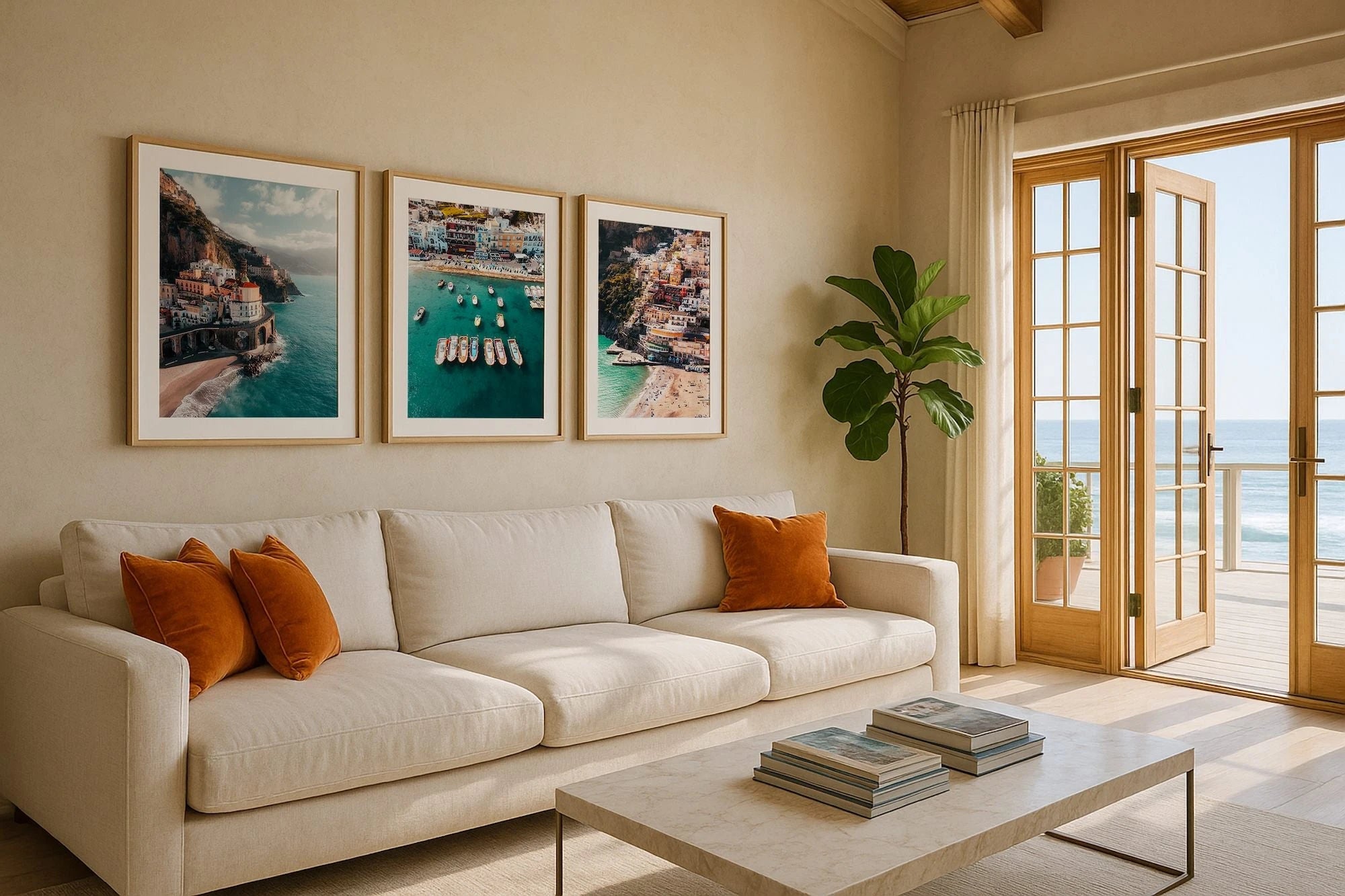



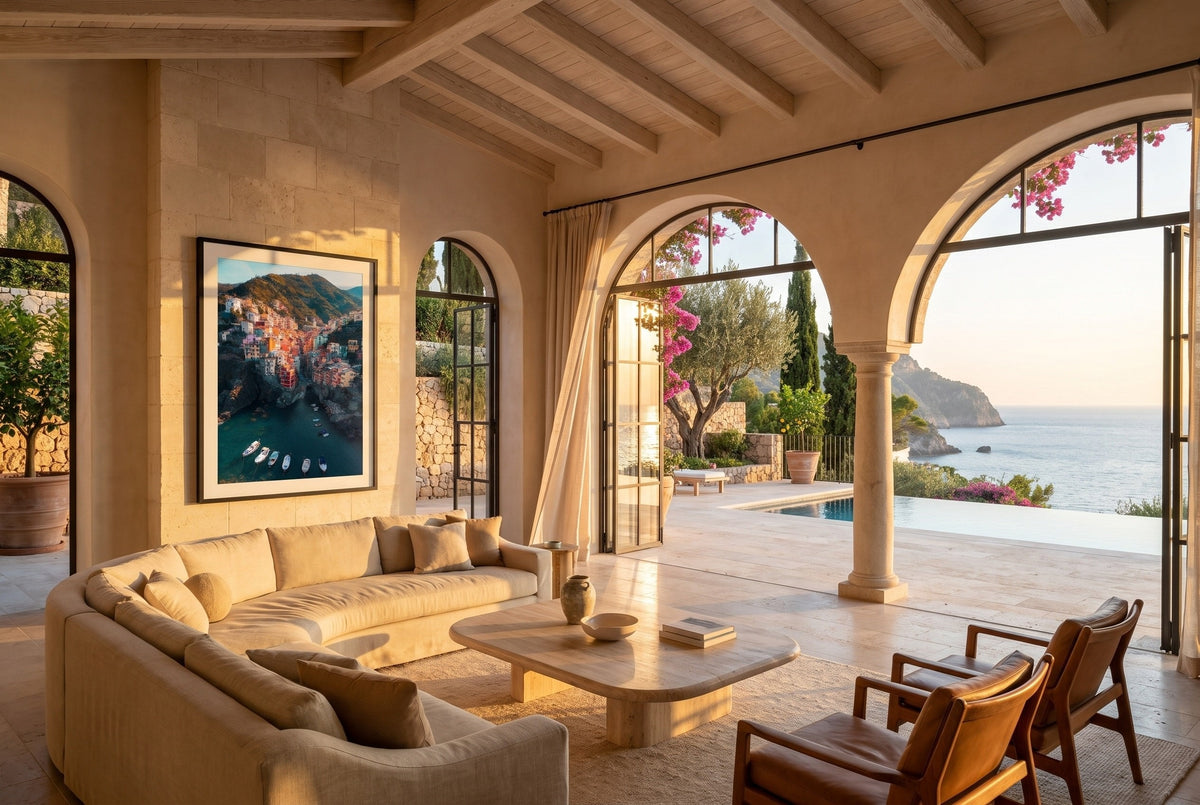
Cinque Terre is one of those places that seems almost too perfectly arranged to be real.
Colourful houses stacked above tiny harbours. Vineyards climbing steep hillsides. Railway lines disappearing into tunnels. Boats sitting beneath villages that appear to have been built directly into the cliffs.
Before photographing it, I knew the familiar views.
What surprised me was how much more interesting Cinque Terre became when I stopped looking only at the villages and started looking at the landscape holding them together.
From above, the scale changes completely.
The buildings become smaller, the cliffs become steeper, and you realise just how little flat land there actually is.
That relationship between people, architecture and landscape became the part I wanted to photograph.
Riomaggiore at sunrise
Riomaggiore appears several times in my Cinque Terre collection.
That wasn't really intentional in the beginning.
Sometimes a place simply keeps giving you different photographs.
At sunrise, the village has a softness that disappears later in the day. The colours are still there, but the light is quieter and the water hasn't yet taken on the intensity of midday.
In Riomaggiore Sunrise, Cinque Terre, what interests me most is how protected the harbour feels.
The colourful buildings rise behind it while the sea opens immediately in front.
It is a very small part of a much larger coastline, but from above you can see how the entire village seems to funnel towards the water.

View Riomaggiore Sunrise, Cinque Terre →
One place, several compositions
I don't think photographing a destination should necessarily mean finding one definitive photograph and moving on.
Sometimes changing your position by a relatively small amount changes the entire story.
That is why there are several photographs of Riomaggiore in the collection.
In one image, the village itself dominates.
In another, the coastline becomes more important.
Move higher again and the buildings begin feeling tiny compared with the cliffs and the Mediterranean around them.
The subject hasn't changed.
Your relationship to it has.
That is one of the things I enjoy most about aerial photography.
From the ground, you are usually photographing what is directly in front of you.
From above, you can photograph how everything relates.
When the light becomes warmer
Sunset gives Riomaggiore a completely different character.
The colours that define Cinque Terre become richer and the buildings begin catching warm light from the side.
In Riomaggiore Sunset, Cinque Terre II, the village sits between two very different visual elements.
On one side is dense architecture.
On the other is almost uninterrupted sea.
That contrast is what makes the photograph work for me.
The buildings are colourful and complex, but the water gives the composition room to breathe.
A single photograph can contain both the intensity of an Italian village and the calm of the Mediterranean.

View Riomaggiore Sunset, Cinque Terre II →
It has also become one of the most collected Cinque Terre photographs in the studio.
I think part of the reason is that you don't need to have visited Riomaggiore to understand the feeling of it.
It looks like somewhere you want to remember.
Vernazza from above
Vernazza has a completely different shape.
The harbour feels more open, with the village wrapping around it rather than simply climbing away from the water.
From above, the stone jetty becomes one of the strongest elements in the scene.
It reaches out into the Ligurian Sea while the colourful buildings gather behind it.
In Vernazza Sunset, Cinque Terre, the late light pulls those elements together.
The harbour, boats, architecture and surrounding landscape all become part of one composition rather than separate subjects.

View Vernazza Sunset, Cinque Terre →
This is one of those photographs where being above the scene changes more than the perspective.
It explains the place.
Standing inside a village, it is easy to concentrate on individual streets, buildings and details.
From the air, you see why the village is shaped the way it is.
The geography came first.
Everything else had to adapt to it.
Manarola and the scale of the coastline
Manarola from Above is one of the newer photographs in the collection, and perhaps the image that most clearly expresses what interests me about Cinque Terre.
The village occupies only part of the frame.
Around it are terraced hillsides, cliffs and a huge expanse of blue water.
There is also a single boat.
It is tiny.
That small detail completely changes the sense of scale.
Without it, the Mediterranean is simply an area of blue within the photograph. With it, you begin to understand how much space surrounds the village.

That is something I look for regularly in landscape photography.
A human figure, a car, a building or a boat can sometimes tell you more about the size of a landscape than the landscape itself.
Manarola is colourful and instantly recognisable.
But in this photograph, I didn't want the village to be everything.
I wanted it to feel like one small part of a much larger coast.
Why Cinque Terre looks different from above
Cinque Terre is often photographed looking towards the villages from the sea or from the walking paths around them.
There is a good reason for that.
Those views are beautiful.
But from above, something else becomes visible.
You begin seeing how aggressively the terrain changes.
Terraces follow the hillsides.
Houses fill almost every available piece of land.
Roads and paths bend around the landscape rather than cutting through it.
Then everything suddenly stops at the edge of the Mediterranean.
It creates photographs with a lot of visual information, but also surprisingly simple shapes.
Land.
Village.
Sea.
That simplicity is one reason many of my Cinque Terre photographs use a vertical composition.
Instead of stretching along the coastline, the frame can move from water, through the village and upwards into the landscape.
It feels closer to how the place itself is built.
Photographing somewhere famous
Like the Amalfi Coast, Cinque Terre comes with an obvious photographic challenge.
Almost everyone has already seen it.
That can make famous places harder to photograph rather than easier.
There is always a temptation to find the exact viewpoint you have seen online and recreate the image.
Sometimes I do visit those viewpoints.
But they are usually only the beginning.
The photographs I end up liking tend to happen when I move away from the idea of photographing a landmark and start looking at shapes, scale, light or a relationship between things.
A harbour surrounded by buildings.
A boat surrounded by water.
A village surrounded by cliffs.
Those elements are specific to Cinque Terre, but they also work visually even if the viewer doesn't immediately recognise where the photograph was taken.
For me, that is usually when a travel photograph has the best chance of becoming something worth putting on a wall.
Cinque Terre or the Amalfi Coast?
The two collections are inevitably compared.
Both are Italian.
Both have colourful villages beside the sea.
Both are places where architecture seems to have been built against impossible landscapes.
But photographically, they feel quite different to me.
The Amalfi Coast feels expansive.
There are sweeping roads, large mountains, villas and towns spread across long sections of coastline.
Cinque Terre feels more concentrated.
Everything seems compressed into a smaller space.
The villages feel tightly connected to the cliffs around them, and the contrast between colourful architecture and open sea can be much stronger.
The Amalfi Coast often makes me want to look across the landscape.
Cinque Terre makes me want to look down into it.
That difference is probably why aerial photography became such a large part of this collection.
Which Cinque Terre photograph works best in your space?
Although the collection comes from a relatively small part of Italy, the photographs can feel very different once framed.
If you want the classic Cinque Terre combination of colourful architecture and Mediterranean water, Riomaggiore Sunset, Cinque Terre II is a natural starting point.
For something brighter and softer, the Riomaggiore sunrise photographs, including Sunrise II and Sunrise III, bring more open colour into a space.
Vernazza Sunset has more visible structure around the harbour and works particularly well if you like architectural detail within a coastal photograph.
And Manarola from Above is the piece I would consider if you want the landscape to feel just as important as the village itself.
Its vertical composition also makes it useful for narrower walls where a traditional horizontal landscape might not work.
The best choice ultimately depends on what you remember about Cinque Terre.
For some people it is the colour.
For others it is the water.
For me, it is how these villages somehow fit into the landscape at all.
From Cinque Terre to your wall
The Cinque Terre collection includes original photographs of Riomaggiore, Vernazza and Manarola, photographed at sunrise, sunset and from above.
Every photograph is available as a made-to-order framed artwork, printed using archival materials and hand-framed in Australia.
The frames are available in black, white and natural oak, with sizes ranging from smaller pieces through to large statement works.
Travel photographs often begin as a way of remembering somewhere.
But once they leave the camera, they can take on another meaning.
A photograph of Riomaggiore might remind one person of a trip through Italy.
For someone else, it might simply be the colour their room needed.
Either way, I like that a tiny village on the Ligurian coast can eventually become part of a completely different place thousands of kilometres away.
Explore the complete Cinque Terre photography print collection →
Comparing Cinque Terre with Amalfi for a home wall? Start with our calm guide to Italy and Amalfi Coast photography prints for the home — colour, scale, and which coast suits which room.