


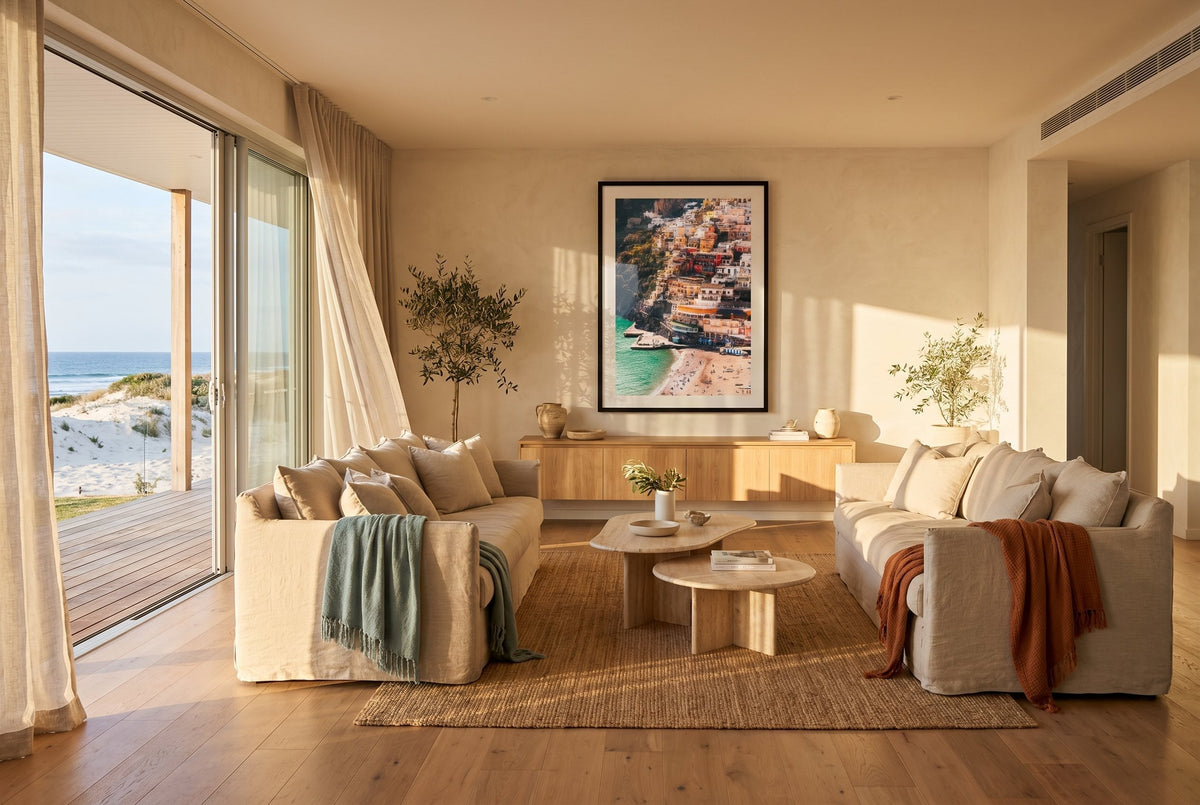
There are some places that feel familiar before you have ever been there.
The Amalfi Coast is one of them.
Positano spilling down the cliffs. Boats sitting on impossibly blue water. Terraces covered in flowers. Tiny towns built into hillsides that don't look as though they should be able to exist there at all.
You have seen these scenes so many times that arriving with a camera creates an unusual problem.
How do you photograph something everybody already recognises?
That became the part I enjoyed most.
Rather than trying to prove how beautiful the Amalfi Coast is, I found myself looking for smaller details, different light and quieter moments within a landscape that rarely needs any introduction.
Positano in the afternoon
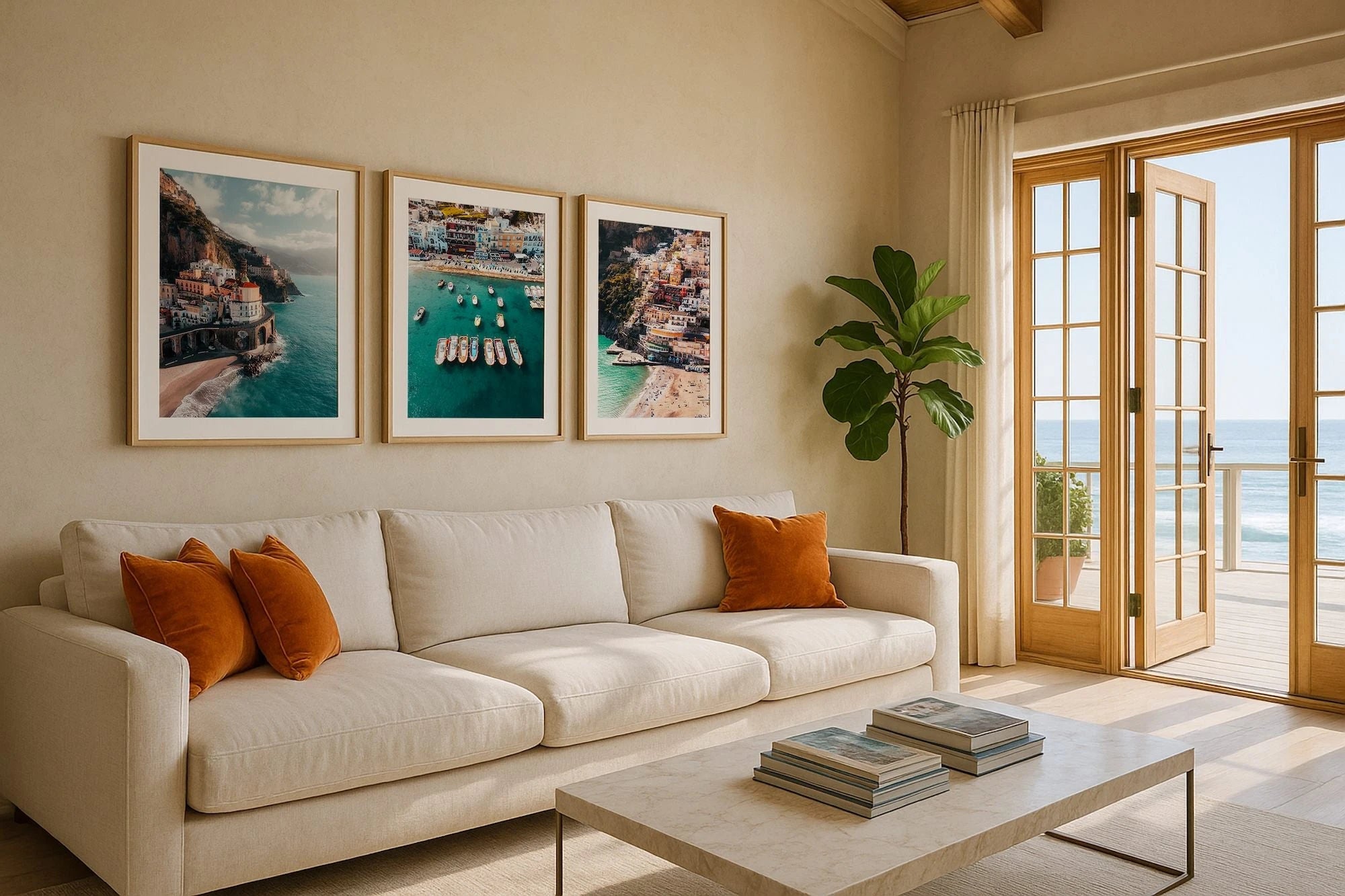
Positano is probably the image most people have in mind when they think of the Amalfi Coast.
Colourful buildings climb almost vertically from the sea, layered one behind another until they disappear into the mountains.
In bright afternoon light, those colours become even stronger.
That is what drew me to Positano Sunny Afternoon, Amalfi Coast.
The photograph isn't subtle, and I don't think Positano should always be photographed that way. Part of what makes the town extraordinary is the density of colour, architecture and landscape all competing for attention at once.
From further away, however, that visual chaos begins to make sense.
The buildings become shapes.
The coastline creates the frame.
And the town starts to feel almost like it has been constructed specifically to be photographed.

View Positano Sunny Afternoon, Amalfi Coast →
Waiting until the colour disappears
The same place can feel completely different once the sun goes down.
One of the reasons I enjoy photographing cities and landscapes around blue hour is that there is a very short period when natural and artificial light exist together.
The sky hasn't become completely dark, but windows and street lights have started appearing.
In Positano, that transition changes everything.
The bright Mediterranean colours become quieter. The town begins glowing from inside rather than being illuminated by the sun.
That is what I wanted to capture in Positano at Blue Hour.
It is still unmistakably the Amalfi Coast, but it feels more cinematic and less like the version people see in the middle of a summer afternoon.

And after blue hour, the town changes again.
In Positano At Night, the landscape becomes almost secondary. Light traces the shape of the hillside, revealing how improbably the town has been built into the cliffs.
Sometimes photographing the same place at different times is more interesting than finding somewhere new.

Atrani before the day begins
A short distance along the coast, Atrani feels very different.
It is smaller and visually quieter than Positano, but photographically that can make it even more interesting.
For Atrani Sunrise, Amalfi Coast, the most important part of the photograph was the light.
Early in the morning, before the coast fully wakes up, the buildings take on softer colours and the entire town seems to sit between the mountain and the sea.
There is less happening.
And that is exactly why the photograph works.
When a place is already visually complex, early morning gives you a chance to simplify it.

View Atrani Sunrise, Amalfi Coast →
I returned to Atrani visually in a few different ways.
Atrani by the Sea places more emphasis on the relationship between the village and the Mediterranean, while Atrani in Black and White removes the colour completely.
The architecture is the same.
The feeling isn't.
That is something I keep noticing when working on a collection. Colour doesn't simply decorate a photograph. Removing it can completely change what you notice.
In colour, you see Italy.
In black and white, you begin noticing shape, texture and the way the buildings stack against one another.

View Atrani by the Sea, Amalfi Coast →

View Atrani in Black and White, Amalfi Coast →
Looking down on the coast
The Amalfi Coast makes a lot more sense from above.
At ground level, everything feels close.
Narrow roads, steep staircases, buildings, terraces, people and traffic all compete for space.
From the air, those same elements become patterns.
The cliffs suddenly show their scale. Roads appear impossibly thin. Buildings seem to cling to the coastline rather than sit on it.
That different perspective is what led to Coastal Positano Black & White.
Removing the colour makes the geography even more obvious.
Instead of seeing a colourful Italian holiday destination, you see the shape of the land and the way people have somehow built a town into it.
It is one of the reasons aerial photography continues to interest me.
Sometimes you need to move much further away from a place before you really understand what you are looking at.

View Coastal Positano Black & White →
Ravello feels different
Ravello sits above much of the activity happening along the coastline.
The perspective changes immediately.
Instead of looking up at mountains from the water, you are looking down towards the Mediterranean.
Villa Rufolo is one of those places where architecture, gardens and landscape seem to blend into one another.
What interested me there wasn't simply documenting an historic villa.
It was the layers.
Stone in the foreground. Gardens around it. Mountains disappearing into the distance. And then the sea.
Villa Rufolo Ravello feels quieter than many of the photographs in the Amalfi collection, and I like that.
Not every photograph of southern Italy needs to be intensely colourful or dominated by the coastline.
Sometimes the atmosphere of the place is enough.

And then there is Capri
Capri isn't technically part of the Amalfi Coast, but visually and geographically it has always felt connected to the story of travelling through this part of Italy.
Approaching the island from the water gives you an entirely different sense of scale.
The cliffs rise almost vertically from the Mediterranean, while Marina Grande sits below them filled with boats.
In Capri Marina Grande, I wanted to keep that relationship between the boats, water and enormous landscape around them.
Seen from a distance, even large boats suddenly look small.
That sense of scale is part of what makes the coastline here so extraordinary.

The Faraglioni rock formations create a completely different kind of photograph.
They have been photographed endlessly in colour, surrounded by blue Mediterranean water.
Photographing them in black and white removes almost everything we associate with a summer holiday in Capri.
What remains is rock, sea, light and scale.
Sometimes taking colour away from a famous place is the easiest way to see it differently.

View Capri Faraglioni Rocks in Black & White →
Photographing somewhere that has already been photographed
The Amalfi Coast doesn't need another photograph proving that it is beautiful.
That isn't really the point.
For me, travel photography becomes more interesting when the question changes from:
“What does this place look like?”
to:
“What did I notice when I was there?”
Sometimes that is the colour of Positano in the afternoon.
Sometimes it is Atrani before most people are awake.
Sometimes it is the few minutes of blue hour when a town begins lighting itself.
And sometimes it is moving far enough away that the famous landmark becomes only a small part of the landscape.
Those differences are what eventually turn a destination into a collection.
Which Amalfi Coast photograph works best in your space?
The Amalfi Coast collection has more variation than the location might initially suggest.
If you want the colour and energy most associated with southern Italy, Positano Sunny Afternoon is the natural place to start.
For something softer and more atmospheric, Positano at Blue Hour has a completely different feeling. The blues and warmer lights can work particularly well in an interior where you want colour without the artwork becoming overly bright.
Atrani Sunrise is quieter and more relaxed, with softer tones that suit light and neutral interiors.
For a more architectural or minimal space, the black-and-white photographs of Positano, Atrani and Capri remove the Mediterranean colour and place more emphasis on structure, contrast and scale.
And if the connection is simply to the feeling of travelling along the Italian coastline, Capri and Ravello offer something less immediately obvious than the classic Positano view.
There isn't really a best photograph.
The right one depends on which version of the Amalfi Coast you want to remember.
From the Amalfi Coast to your wall
Every photograph in the Amalfi Coast collection began as a real moment photographed while travelling through this part of Italy.
The collection includes Positano, Atrani, Ravello and nearby Capri, ranging from colourful coastal landscapes and blue-hour scenes to more minimal black-and-white aerial photography.
Each photograph is available as a made-to-order framed artwork, printed using archival materials and hand-framed in Australia.
Black, white and natural oak framing allow the same photograph to feel very different depending on the space it eventually lives in.
I have always liked that part of photography.
A moment that lasted a fraction of a second somewhere on the Italian coast can eventually become something somebody looks at every day on the other side of the world.
Explore the complete Amalfi Coast photography print collection →
For a calm shortlist of Amalfi and wider Italy framed prints for home walls, see Italy and Amalfi Coast photography prints for the home.