


Some photographs are planned for weeks.
This one happened because I walked across the road from my hotel.
In 2019, I travelled alone to Yangshuo in southern China before heading home to spend Chinese New Year with my family. I had seen photographs of the area many times before: the Li River winding between limestone karst mountains, bamboo rafts drifting through mist, and fishermen working on the water with cormorants.
I was born and raised in China, but I had never been to Yangshuo.
That is something I find interesting about travel. Sometimes we know places on the other side of the world better than places within the country where we were born.
I went there wanting to photograph the landscape.
I came home with a portrait of a man I had never expected to meet.
And eventually, that photograph would be seen more than 40 million times.
Arriving in Yangshuo
The weather wasn't particularly good when I arrived — cloud, grey light, and very little of the dramatic sunrise or sunset I normally hope for.
So I did what I usually do when conditions don't cooperate.
I explored.
I walked through town, cycled through the countryside and ate far too much Yangshuo beer fish, which somehow turned into a nightly ritual during the trip.
The limestone mountains rise almost vertically from the flat ground. The Li River passes quietly between them, and depending on the weather, the distant peaks appear and disappear into mist — a landscape that has shown up in Chinese paintings for generations.
But the photograph I remember most from that trip wasn't really about the landscape.
It was about Lao Huang.
Meeting Lao Huang beside the Li River
The Li River happened to be directly across the road from my hotel.
One morning, I walked over to have a look.
That was it. No organised photoshoot. No location scouting. No production.
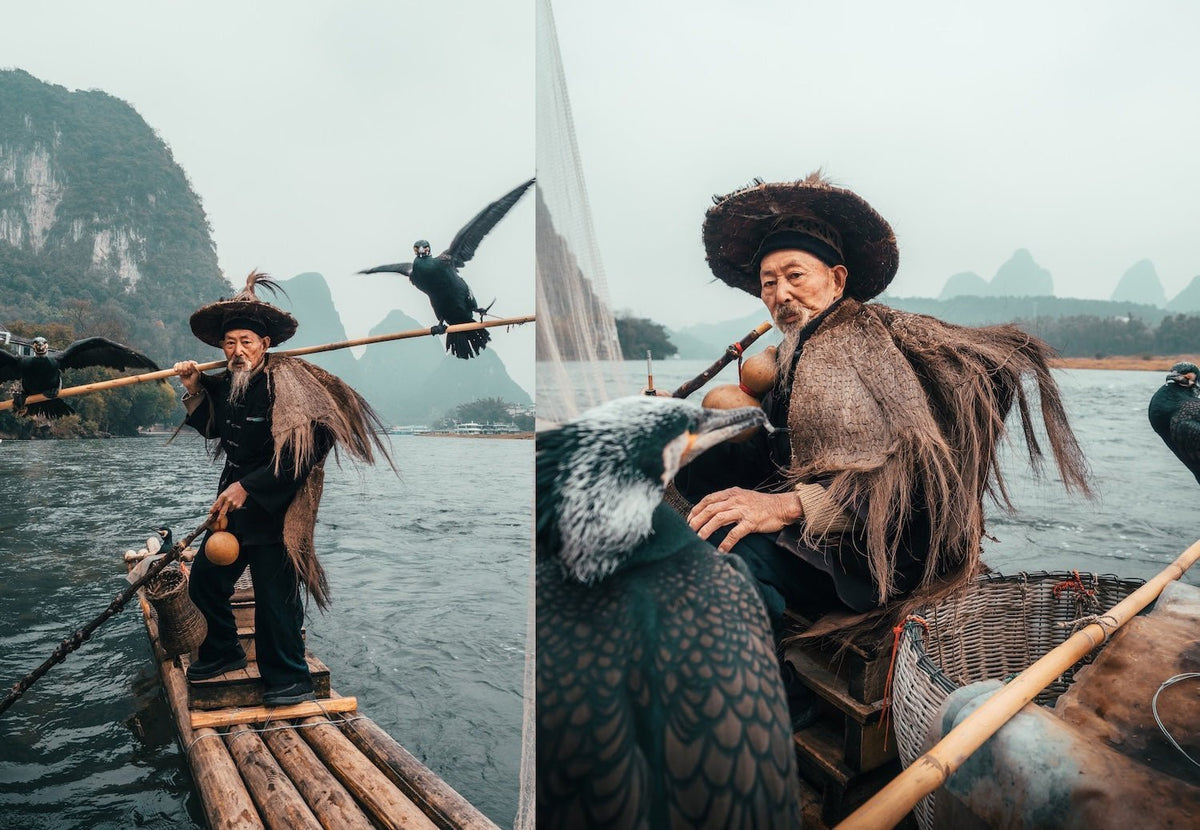
When I reached the river, I noticed an elderly fisherman preparing his bamboo raft and cormorants.
I greeted him and asked whether I could take a few photographs.
He said yes.
His surname was Huang. He was 86 years old at the time, and locals called him Lao Huang — Old Huang.
As we talked, he told me that he had been around fishing since he was a child. He and his brother had learned how to train cormorants from their father.
I had gone down to the river looking for photographs.
Instead, I found myself listening to his story.


What is cormorant fishing?
Cormorant fishing is a traditional method where fishermen work with trained cormorants to catch fish. It has been practised in China for more than a thousand years, including along the Li River around Guilin and Yangshuo.
Historically it was a genuine livelihood. Today, in places like Yangshuo, it survives largely through demonstrations, tourism, and a shrinking number of people who still know the practice.
Lao Huang told me that for him, it was no longer really a way to make a living from catching fish. It had become something he continued because it was part of his life. He also bred the birds and received money from visitors who came to photograph and see the tradition.
I don't want to pretend I discovered an untouched fishing tradition that nobody else knew existed. I didn't. What I encountered was a man continuing something passed from his father, in a world where that knowledge was no longer required in the same way.
That is the story I wanted the photographs to hold.
Making the photograph
What struck me immediately about Lao Huang was his face — the long white beard, the traditional clothing, the woven hat. Then the birds: strong shapes and textures, black feathers catching small highlights, wings that could change the whole composition in a second. Behind everything, the misty limestone mountains of Yangshuo.
It almost looked too perfectly arranged. But nothing was static. The birds moved. Lao Huang moved. The raft moved beneath him. I kept photographing.
Sometimes in travel photography, you know immediately when a scene has potential. That doesn't mean you know which frame will become important. I certainly didn't look at the back of the camera and think this would reach 40 million people.
I just knew I didn't want to stop shooting yet.

How the photograph travelled
After the trip, I shared the photographs online. People started sharing them again. The images spread across Instagram, Facebook and other platforms, eventually reaching more than 40 million views.
For a photograph made during an unplanned morning walk beside the Li River, that still feels slightly ridiculous. It also became one of the images people most strongly associate with my work. My Modern Met later interviewed me about Lao Huang and the story behind the image.
But the number of views isn't the part that stayed with me. It is what people responded to.
It wasn't an impossible location or extraordinary equipment or months of planning. I think people responded because the photograph already held a story: an elderly fisherman, the birds, the bamboo raft, the mountains disappearing into the distance. Immediately you want to know who he is, why the birds are with him, and whether this way of fishing still exists.
A beautiful landscape shows you somewhere. A person can make you wonder about a life.
There is an irony in calling this my most viral photograph. Nothing about making it was designed for an algorithm. I met an interesting person in an extraordinary place and tried to do justice to the moment. Then the internet decided what happened next.
You can study platforms. You can't reliably manufacture the thing that makes millions of people feel something. The photograph has to come first.
Eventually, people began buying the photograph for their homes — a morning beside the Li River becoming a framed piece on a wall thousands of kilometres away. The original moment lasted minutes. The photograph keeps moving.
What the photograph became afterwards
Photography has a strange relationship with time. When you press the shutter you are thinking about light, composition, timing. Years later the photograph becomes a record.
Lao Huang was 86 when I met him. He had learned this from his father. The world around him had already changed enough that cormorant fishing was no longer the livelihood it once was. I happened to be there for a very small piece of that story.
It would be easy to turn this into something romantic about an old China disappearing. I don't think it is that simple. Traditions change because people's lives change. A practice fading isn't automatically something that should have stayed frozen forever. But it is worth documenting — looking at those moments without pretending we can stop the world around them.
Document what is there. Talk to people. Understand as much as you can. Then make the photograph honestly.
Sometimes talking to someone matters more than the camera
Looking back, one of the most important decisions I made that morning wasn't photographic at all.
I said hello.
If I had simply stood at a distance with a long lens, I might still have made an interesting photograph. But I wouldn't have known Lao Huang's name, his age, that his brother also trained cormorants, or that their father taught them.
Without that conversation, I would have come home with a photograph of a cormorant fisherman.
Instead, I came home with a photograph of Lao Huang.
There is a big difference. That lesson has stayed with me. Travel photography isn't always about observing people from the outside. Sometimes you need to put the camera down for a minute and talk.
The photograph I didn't travel to Yangshuo to take
I didn't travel to Yangshuo specifically to photograph Lao Huang. There was no moodboard, no scheduled portrait, no guide. He happened to be across the road from my hotel, and I happened to walk down to the river that morning.
Some of the most important photographs in my career have happened this way. You travel because you think you know what you want to photograph. Then something else happens.
Planning gets you into the right places. Curiosity makes you notice what you didn't plan for.
The photographs of Lao Huang
I made several photographs during that encounter rather than a single frame. Each tells the story slightly differently.
Cormorant Fisherman of Yangshuo I
This is the photograph most closely associated with the series — Lao Huang on his bamboo raft with his cormorants, karst mountains behind him. The landscape gives the photograph a place. Lao Huang gives it the story.

View Cormorant Fisherman of Yangshuo I →
Cormorant Fisherman of Yangshuo II
The second photograph changes the relationship between Lao Huang, the birds and the landscape. A tiny change in timing can completely change the character of a portrait — which is why I prefer showing several frames from an encounter like this.

View Cormorant Fisherman of Yangshuo II →
Cormorant Fisherman of Yangshuo III
The third photograph gives another view into the same morning on the Li River. Together, the series feels closer to how I remember the encounter than any single frame can.

View Cormorant Fisherman of Yangshuo III →
Why Lao Huang remains one of my favourite photographs
It would be easy to say I love this photograph because it became successful. I think the opposite is closer to the truth. It became successful because it already held the things I love about photography — travel, curiosity, people, culture, landscape, an unexpected encounter, and a moment I couldn't recreate if I tried.
I've photographed many places since that morning. Some required more planning. Some were more dramatic or technically harder. But Lao Huang remains one of the photographs I return to.
Not because it reached millions of people.
Because before any of that happened, there was just an 86-year-old man beside the Li River, his birds, a camera, and a conversation I hadn't planned to have.
Sometimes that is enough.
Explore the Cormorant Fisherman of Yangshuo framed print series →
Explore the China photography collection →
Want a print for the wall? Start with our Featured framed prints — the studio shortlist, hand-framed in Australia and delivered ready to hang.